By Jonah Pesikoff ’23 and Ben Gordon-Sniffen ’23
On August 23, 1939, Adolf Hitler and Joseph Stalin signed the Molotov-Ribbentrop Pact, a non-aggression agreement that divided Eastern Europe into German and Soviet territories. Just over a week later, on September 1st, 1939, Nazi Germany invaded Poland, bringing huge numbers Jews under German control. The Soviet Union followed suit on September 17, 1939. Nazi occupiers rounded-up native Jewish populations and sent them to ghettos, mainly in large cities like Warsaw, Lublin and Vilna.
In June of 1941, Germany launched Operation Barbarossa in an attempt to conquer the Soviet Union. Fighting between Nazi Germany and the U.S.S.R. was chaotic, violent, and unrestrained. Anti-semitic policy also worsened with Operation Reinhard: the construction death camps specifically to destroy the Polish Jewry. In the latter years of the war, German forces “liquidated” Eastern European ghettos and sent Jews to the extermination camps like Treblinka, Sobibór and Bełżec. Hitler also deployed the Einsatzgruppen, a specialized mobile-killing unit of the SS, to massacre Jews and Roma in the Soviet borderlands.
The Holocaust in the Soviet Union was more violent and destructive than anything seen in the West and remains an important, but often overlooked, part of Holocaust history. In this section, you can find information about the Einsatzgruppen, Jewish Partisans, Jews in the Red Army, the Red Army discovery of the Nazi’s most notorious execution sites and camps, and suggestions for further reading.
Einsatzgruppen
Einsatzgruppen directly translates to “action-groups,” and are commonly known as “Mobile Killing Squads.” These SS units murdered between 1.5 and 2 million Holocaust victims primarily through mass shootings and gas vans. The Nazis divided the Einsatzgruppen into four different units, Einsatzgruppe A, B, C, and D (seen below). Mobile Killing Squads followed the Wehrmacht (German Army) into the Soviet Union, killing Jews, Polish political outcasts, Roma, and people with disabilities (seen below). The Einsatzgruppen are most remembered for their involvement in “Operation Barbarossa,” the invasion of the Soviet Union.
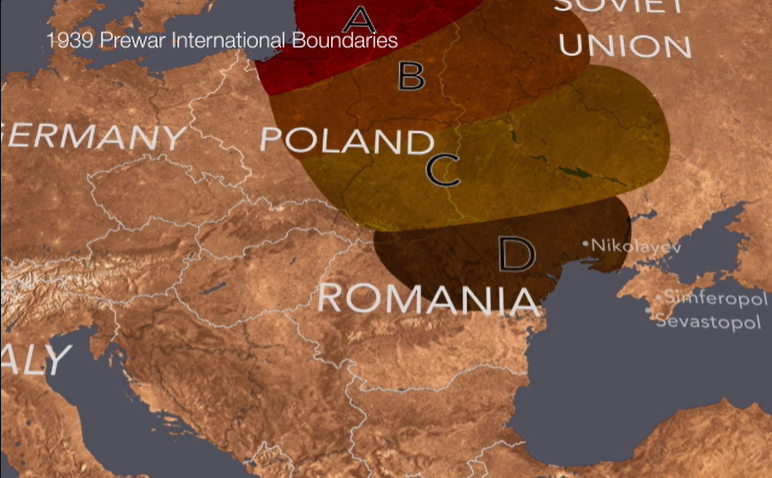
Einsatzgruppen movement across the Soviet side of the Molotv-Ribbentrop line. 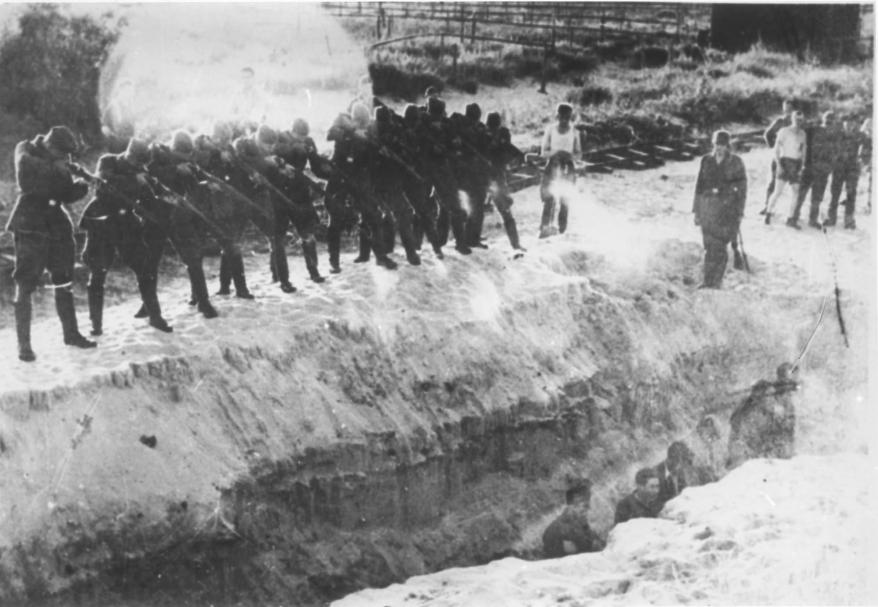
Originally, Einsatzgruppen terrorized Jews in order to force them east from the German side to the Soviet Side. The Einsatzgruppen were utilized for this particular function in 1938 and 1939 when Germany invaded Austria, Czechoslovakia, and Poland.
As World War II escalated, the Nazi’s cemented their plans for the Final Solution and deployed the Einsatzgruppen to carry out the Holocaust. In 1941, Einsatzgruppen massacred over 33,000 Jews at the Babi Yar Ravine. From 1941 to 1944, Einsatzgruppen murdered more than 75,000 Jews at Ponary, the killing site of Jews in Vilna, Lithuania. On many occasions, the Einsatzgruppen conscripted locals to help facilitate these massacres. Nazi atrocities helped decimate the Jewish population of Eastern Europe and render the Einsatzgruppen one of Hitler’s most notorious creations.
Before the Holocaust, many Jews inhabited small towns known as shtetls. For example, the village of Ejszyszki housed around 4,000 Jews by the year 1941. On the eve of the Jewish New Year, Einsatzgruppe A brought all Ejszyszki Jews to a cemetery for mass murder, killing each one of them. In 1925, Jews comprised 70% of the Ejszyszki population. Today, zero Jews live in Ejszyszki. Destroying these small towns dismantled the final shtetls, thus ending traditional Soviet Jewish life.
In addition to wiping out small towns like Ejszyszki, Mobile Killing Squads helped commit some of the largest mass murders in history. Although not always directly killing the marginalized groups, the Einsatzgruppen was responsible for assembling the infrastructure for local Nazi collaborators. One such instance was in October, 1941 at Odessa. This modern-day Ukrainian city is home to the largest single massacre in World War II.
After a bomb exploded in the Romanian headquarters, authorities blamed Jews and proceeded to murder 55,000 Jewish residents. During the Odessa massacre, Einsatzgruppen and Romanian soldiers forced 22,000 Jews into a bunker to be burned alive. Mishka Zaslavski, the only known person to survive the Odessa bunker, commented in 2018 that “the whole neighborhood is built on bones.” Because Zaslavski is the only known survivor, he is the only source of information we have about the bunker. Historians rely on accounts like Zaslavski’s to better understand the Holocaust, and look through the eyes of people who experienced it. As the last generation of Holocaust survivors pass on, it has become paramount that we gather as much knowledge as possible because in some cases, survivors are the only sources we have.
Einsatzgruppen committed similar atrocities at Ponary, a killing site outside Vilna, Lithuania. Vilna was once the home of 54,000 Jews and served as the epicenter of Jewish culture in Eastern Europe. During the Holocaust, though, the Einsatzgruppen forced Jews and other prisoners to dig pits 12 to 23 meters wide and 5 8 meters deep (seen on the right). From June 1941 to July 1944, Einsatzgruppen and Nazi collaborators slowly decimated the Lithuanian Jewish population. Kazimierz Sakowicz, a Polish journalist, noted that Einsatzgruppen took groups of “about 300 people, all with bundles … [to] Ponaryーthe settlementー‘for work.’” Those taken to Ponary were seldom heard from again. Barring an unlikely escape into the nearby forests of Lithuania, people who went to Ponary were forced to hand over their clothes and their valuables. After entering the pit, each prisoner was shot and killed. While the Einsatzgruppen were not directly responsible for each murder, they made the Ponary massacres possible, gathering locals to carry out the Final Solution for Vilna Jews.

The Einsatzgruppen took on a more prominent role in one of the most well-known mass killings today, the massacre of Babi Yar. In 1941, the 160,000 Jews who resided in Kiev made up roughly 20 percent of the city’s population. On September 29th and 30th, the Einsatzgruppen murdered 33,771 Jews in the Babi Yar Ravine, just outside of Kiev. This total makes Babi Yar the third most-deadly massacre in the Holocaust, behind Odessa and Operation Harvest Festival. After the initial killings, Einsatzgruppen and local officials murdered thousands more Jews, Roma, and Soviet prisoners, bringing the estimated death toll to around 100,000. A truck driver at Babi Yar encapsulated the horrific scene:
Once undressed, the Jews were led into the ravine which was about 150 meters long and 30 meters wide and a good 15 meters deep…When they reached the bottom of the ravine they were seized by members of the Schultpolizei and made to lie down on top of Jews who had already been shot. That all happened very quickly. The corpses were literally in layers. A police marksman came along and shot each Jew in the neck with a submachine gun … I saw these marksman stand on layers of corpses and shoot one after the other … The marksman would walk across the bodies of the executed Jews to the next Jew who had meanwhile lain down and shoot him.
From the truck driver’s description we can see the Einsatzgruppen completely dehumanize whole populations. This person’s account is one of the most detailed we have about Babi Yar. For the most part, Nazis did not delineate their work outside of some statistics and bookkeeping. While these numbers are important for historical record, primary sources are quintessential to drawing a more complete picture of the Holocaust. Many Holocaust survivors have given oral histories or even written books to document their experience. Although we are unable to hear the stories of those who perished in the Holocaust, surivor accounts enhance our understanding of the Holocaust. Stories like the truck driver’s at Babi Yar are especially important for events in the Eastern Front where documentation was scarce. Babi Yar now exists as a symbol of Nazi atrocities and has been the inspiration for many artists looking to depict the Holocaust. For example, famous Soviet composer Dmitri Shostakovich wrote his 13th symphony as an ode to those murdered at Babi Yar.
After Nazis realized that mass shootings could cause psychological trauma for the shooters, Einsatzgruppen searched for a more efficient way to kill large numbers of Jews. Nazi scientists devised gas vans to serve this purpose. Up to 60 Jews were loaded into trucks with the exhaust pipe running into the back side of the truck. As the truck drove to the mass graves, carbon monoxide would flow from the exhaust pipe and enter the compartment of Jews. Here, the prisoners would die from asphyxiation. This method of killing Jews proved quick and cost efficient. Einsatzgruppen killed around 700,000 with gas vans, but this invention became obsolete once gas chambers were invented to murder Jews in even higher numbers. The Einsatzgruppen can be thought of as a precursor to the Nazi death camps.
The Einsatzgruppen was one of the most frightening branches of the Nazi army, killing almost one third of all Jews who perished in the Holocaust. Their actions not only ended lives but also changed the Jewish landscape in the Soviet Union. Large cities in Eastern Europe are no longer cultural centers for Jews and shtetls are completely extinct.
Partisan Groups
Partisan groups were one of the most important ways Jews resisted the Nazis during the Holocaust. Most of the time, Jews who joined partisan groups had escaped ghettos and labor camps or had evaded these spaces to begin with. Once a partisan group was formed, they engaged in clandestine retaliation against the Nazi occupiers. Partisan groups mostly sabotaged Nazi infrastructure by cutting off supply lines or destroying roads, but they were also known to hunt and kill Nazis. Timothy Snyder, an Eastern European historian, writes that “partisan units were meant to defeat the German occupation, not to help civilians endure it.” In total, an estimated 20,000 to 30,000 Jews fought in partisan organizations throughout World War II. While operating all across Europe, partisan groups were far more common in the Eastern Front, and specifically the Soviet Union (seen below).

Those who escaped concentration camps often joined partisan groups in order to survive. For example, about half of the 10,000 Minsk Jews who joined Soviet partisan units survived the war. Those who did not escape to partisan groups were most likely killed in an Einsatzgruppen massacre or a death camp. Jews in the Vilna ghetto escaped to nearby forests and hid until they could join up with local partisan organizations. The dense forests in Eastern Europe provided protection from Nazis and served as the home to many partisan groups. Some partisan groups were composed of people from diverse backgrounds, while others were specifically Jewish or affiliated with the Red Army.
One of the most important partisan groups was the Bielski group. Tuvia Bielski, a Belorussian Jew, led an extremely successful partisan group that, at its peak, had 1,230 members. In contrast to the other partisan groups’ sabotage missions, Bielski attempted to rescue as many Jews as possible. Because so few Jews remained in Europe after the inception of the Holocaust, Bielski commonly said that “To save a Jew is much more important than to kill Germans.”
Bielski’s group did not just save Jews, though. The partisan organization destroyed bridges, German trains, and railroads. Interestingly, more than 70 percent of those saved were women, children, and elderly people. These groups were more likely than men to perish in the Holocaust because Nazis sometimes enslaved men rather than executing them. Of the 1,230 people who Bielski saved, it is likely that every one of them would have perished in the Holocaust. Bielski’s tactical commitment to rescue Jews rather than kill Germans proved ultimately effective and helped one of most important partisan groups save more lives than any other during the Holocaust.
Bielski’s partisan group is depicted in the 2008 movie Defiance, starring Daniel Craig. This Academy Award-nominated film has helped disseminate important information on not only Bielski, but partisan groups more broadly. Although dramatized for Hollywood, films and other media have been crucial to keeping alive the memory of the Holocaust.
Another well-known partisan group was that of Abba Kovner (seen below). In contrast to Bielski’s ideology, Kovner believed that violence against Nazis was key to defeating Germany. Kovner once said:
Jewish youth! Do not trust those who are trying to deceive you. Hitler plans to destroy all the Jews of Europe — We will not be led like sheep to the slaughter! True, we are weak and defenseless, but the only reply to the murderer is revolt! Brothers! Better to fall as free fighters than to live by the mercy of the murderers. Arise! Arise with your last breath!
quoted in Bartrop, p. 138
Kovner’s organization became acclaimed for destroying over 180 miles of train tracks, 5 bridges, 40 enemy train cars, killing a reported 212 enemy soldiers and rescuing at least 71 Jews. Unlike many partisan groups, Kovner refused to merge with Lithuanian or Russian organizations to grow its numbers. It is difficult to determine the effectiveness of Kovner’s group because we are unable to measure how much its actions helped Jews. Regardless of its efficacy, though, Kovner’s partisans were symbols of Jewish resistance and their actions provided hope for Jews across Europe.
After the Holocaust ended, Kovner continued to be influential in its memory. Kovner testified against Adolf Eichmann in his 1961 trial. Furthermore, Kovner won the 1970 “Israel Prize” in literature for his Holocaust-inspired poetry. Kovner passed away in 1987 but is still remembered as essential figure in the Holocaust for his resistance against Nazis and his work to preserve the memory of those who perished under the Nazi regime.
Partisan groups were essential to saving important Jewish lives and helping defeat the Nazis. Although unclear how much partisan groups helped in terms of sabotage, it cannot be overlooked the lives these partisan groups saved. In a time when 6 million Jews were indiscriminately massacred, even one life was important to saving Jewish culture. Partisan groups symbolized Jewish resistance and a drive to save humanity in a time when many believed all hope was lost for European Jews.

Jews in the Red Army
While most of the historical Jewish WWII fighters fought in partisan groups, like Tuvia Bielski and Abba Kovner, many Soviet Jews fought and traveled with the Red Army. Over the course of the war, an estimated 350,000-500,000 Jews served the Red Army in various capacities. Of the hundreds of thousands of Jews who served in Soviet Forces, 120,000-142,00 died in service (Yad Vashem).
The Jewish presence in the Red Army tells the Jewish narrative of World War II outside of ghettos and concentration camps. Jewish experiences in Soviet forces show the resolve of Jewish people and provide us with accounts of Nazi atrocities from people who witnessed the carnage first hand. These Jews served in various positions outside of the fighting, many educated Jews served as doctors or in a political role. Many Jewish writers at the front recorded crucial information about the Holocaust and Jewish military exploits, most reporting back to the Jewish Anti-Fascist Committee (JAC). When the Red Army went on the offensive after Stalingrad, many Jewish Partisans and escapees joined the Red Army in its advance towards Berlin. Jewish involvement in the Red Army had many facets and unique stories, but all combined to one collective Jewish history and perseverance and strength.
The Jewish Anti-Fascist Committee collected and published many accounts of Jews at the front. Ukrainian Jew Vasily Grossman, a journalist by training, spent most of the war at the front collecting stories, many of which came from Jewish Soldiers. One of these soldiers was a commissar for an artillery battalion named Mordukhovich. Even as a Jew, Mordukovich had a significant role in the Red Army, and showed bravery outside of battle. After one of his best soldiers was unjustly sentenced to death for desertion, Mordukovich hid the man for nearly a week. Mordukovich finally convinced the company to spare the man (Grossman, 99). The bravery of this Jewish commissar, hiding the condemned soldier at great risk to himself, is just one example of how Jews in Soviet forces used their positions to help others.
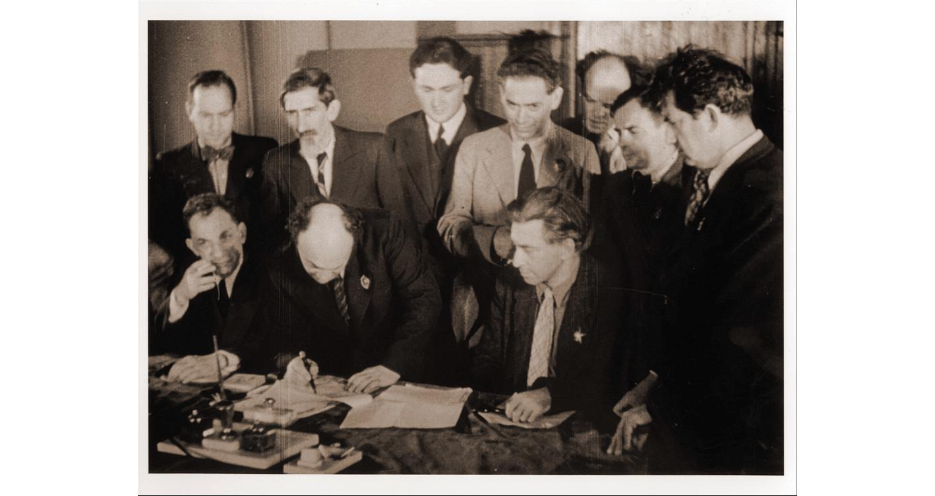
Another one of these soldiers was a Jewish commander of a motorized rifle battalion, Captain Kozlov. Prior to the war, Kozlov studied music at the Moscow conservatoire. Grossman recorded a conversation with the man, an account full of the emotions of a Jewish soldiers, brave but ready to die at any moment. In the army Jewish soldiers were not known for this type of reckless bravery. Despite the ferocity of partisan groups, Jews had the reputation for being “bad soldiers.”
Even Kozlov reflected this belief, telling Grossman he thought Jews weren’t fighting well enough, and that they should be fighting like fanatics (Grossman, 96). Most likely bred out of Soviet anti-Semitism, the notion that Jews were bad fighters shows the challenges Jewish soldiers faced from both external and internal threats. Aware of this stereotype, Jews in the Red Army and partisan units wrote patriotic songs celebrating the Soviet Union as well as the Jewish struggle.
The JAC collected many accounts from soldiers like Kozlov and Mordukhovich the during the war as well as witness accounts to the Holocaust, and attempted to share stories in a project called The Black Book of Soviet Jewry. Unfortunately, due to Soviet political motivations after the war , the work of the group was seen as treasonous. The Soviet government would go on to arrest and execute 12 members of the JAC in 1952, despite their brave and important work for the Soviet Union during the war. The persecution of these men symbolizes the struggle of Jews in the Red Army, despite their bravery and heroism they were still seen as adversaries. After the war, the Red Army awarded thousands of Jewish soldiers with military honors, though the stories of these heroes are often neglected.

Many of these soldiers eventually emigrated to Israel, though not until long after the war. Even in Israel, these soldiers were not commemorated for their service until the erection of a monument in their honor in 2012. Still, the bravery of Jewish soldiers in WWII provide detailed records of the trauma of war and an alternative Jewish history during a time of such persecution.
Red Army Liberation and Witness
If the German offensive into Soviet Russia precipitated the first mass murders of the Holocaust, the Red Army’s push back across Europe helped to uncover it. The Red Army discovered acts of German atrocity at death camps, ghettos and execution sites. Writers in the Red Army recorded in detail the extent of German war crimes as they advanced through Eastern Europe, interviewing survivors and witnesses at places such as Majdanek, Lublin and Treblinka.
Many of these writers were Soviet Jews who walked the fine line of Soviet remembrance, trying to celebrate the Jewish identity of the victims against the wishes of the Stalinist regime. With new groups coming under Russian control, Stalin wanted to ingratiate subjects in recently acquired land, and not focus on the disproportionate victimhood of Jews. The Stalinist line of “Do Not Divide the Dead” (Grossman, 250) refused to make special accommodations for ethnic groups targeted by the Nazi’s, and instead saw German crimes as collective Soviet suffering.
Still, Jewish writers worked together to both document German war crimes, and also to commemorate the losses of the European Jewish community. One of these writers in the Soviet Army was Vasily Grossman. Grossman was a Ukrainian Jewish journalist who volunteered for the Red Army after the German invasion of 1941. Of the next four years of the war, he spent three on the front lines, recording battle information and interviewing soldiers in various companies.
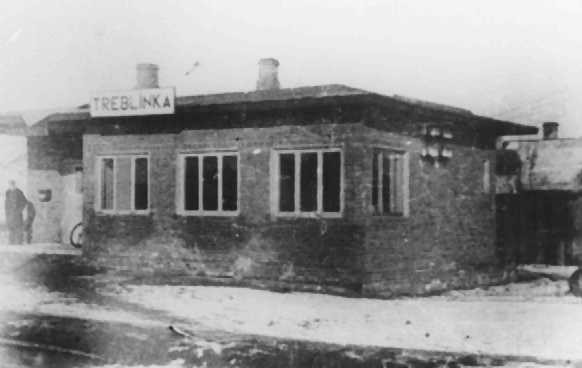
As the Red Army moved east, Grossman was one of the first reporters to visit Majdanek. Later, he visited the extermination camp of Treblinka and curated a report entitled “The Hell Called Treblinka,” a harrowing narrative of experiences from Sonderkommandos and Polish peasant witnesses. Grossman’s account of the extermination camp became one of the most important in Holocaust history, for its saddening account of the last moments of victims and also the brutal damnation of German cruelty.

Grossman was a member of the Jewish Anti-Fascist committee, a Soviet group which took it upon themselves to commemorate the losses of European Jewry. Stalin himself created the group as one of five anti-fascist committees in the winter of 1941 with the goal of appealing to Western democracies and facilitating allyship. Red Army advancements and discovery of Nazi massacres fueled the group’s literature, with Grossman and fellow writer Ilya Ehrenburg recording what they saw at the front.
The JAC authorized Grossman and Ehrenburg to organize the Black Book, a collection of documents and testimony about the Holocaust in the Soviet Union. Soviet Authorities tolerated the group and their findings, as they showed the atrocities committed by the Germans and the organization helped the USSR keep in good standing with Western Allies. Unfortunately, after the war as the Cold War began, Stalin began to trust the group less and less, culminating in a refusal to publish the Black Book and execution of twelve of the group’s members in 1948.
Despite the desire to repress evidence of victims’ ethnicity, the Red Army’s march through Europe still revealed the extent of German war crimes, especially concentration camps. The first liberation of a major camp came in July 1944, when Soviet troops advanced into Majdanek, a concentration and death camp outside of Lublin. Majdanek had been a prisoner of war camp for Soviet soldiers before the Nazi’s turned it into a concentration and extermination camp. Because of the mixed legacy of Majdanek, and the diverse composition of victims (Jews, Poles and Russians), the Soviet Union turned the liberation into a piece of propaganda. As to avoid any emphasis on the largely Jewish victims of the camp, a Russian strongly sympathetic to the Stalin regime named Konstantin Simonov recorded the liberation and discovery (Grossman 280).

Further north, the 1st Belorussian front discovered Treblinka at the same time as the Stalingrad Army liberated Majdanek. The Soviet regime allowed Grossman to travel to the extermination camp, where he interviewed local witnesses and the forty survivors the Red Army found (Grossman 280). From these experiences Grossman curated “The Hell Called Treblinka,” his most powerful piece of writing. The account was featured at the Nuremberg trials. Despite Grossman’s strong ties to the European Jewish community, his piece contained little reference to Jewish identity, and focuses instead on German cruelty.
All witnesses mentioned the atrocities of one humanlike creature, an SS man called Zepf. He specialized in killing children. This beast, who possessed a massive physical strength, would suddenly seize a child out of the crowd, and either hit the child’s head against the ground waving the child like a cudgel, or tear the child in two halves.
Vasily Grossman, “The Hell Called Treblinka”
The victims of the camp saw the Red Army as heroes who would exact revenge on the Nazis. Survivors told Grossman a story of how as a boy entered the gas chamber, he shouted “Russia will take revenge! Mama, don’t cry!” (Grossman, 296). The lack of emotional language surrounding the Jewish struggle speaks to the difficulties Grossman faced recovering and recounting trauma. Despite his deep personal connections (the Nazi’s killed his mother in Ukraine in 1941, and he would have found out around the time of the articles publishing), Soviet requirements to condemn Nazi’s shifted the focus away from Jewish victims as the JAC intended and onto perpetrators.
Grossman’s testimony recreates the experience of victims at Treblinka, using survivor accounts to piece together how the camp operated. This replication was among the first published accounts of what victims experienced at the camp, as Nazi’s attempted to destroy evidence of the Final Solution. Because of the Soviet Army advance, the Germans razed the extermination camps of Treblinka, Sobibór and Bełżec (USHMM). This destruction came on direct orders from Heinrich Himmler, who flew into Treblinka in 1943 and told the camp leader to destroy all evidence of the extermination, even exhuming previously buried corpses to be burned (Grossman, 296). German attempts to cover their tracks did not always succeed, as the Red Army advanced on to Majdanek, the Germans had left the crematoria burning as they retreated.
Not all Red Army liberations came to dilapidated camps. In January of 1945 Soviet forces liberated Auschwitz, the largest Nazi concentration and death camp. While Nazis had made attempts to cover up the scale of extermination at Auschwitz, much of the evidence remained. Red Army discoveries at the camp provide much of the foundational knowledge of Auschwitz. In addition to the 6,000-7,000 emaciated prisoners left behind at the camp, Soviet forces discovered hundreds of thousands of both men’s and women’s outfits, and 14,000 pounds of human hair.
There are no Jews in the Ukraine… All is silence. Everything is still, A whole people has been brutally murdered.
– Vasily Grossman, “Ukraine without Jews”
The Red Army’s push towards Berlin revealed Nazi atrocities outside of constructed camps. As Russian forces moved south liberating Ukraine, General Vautin’s 1st Ukrainian Front heard reports of the Babi Yar massacre. Witnesses told Grossman of the autumn 1941 killings, and the German deceit of telling Jews they were being taken to Germany before being stripped naked and murdered at Babi Yar.
Much like the German destruction of evidence at the extermination camps, Soviet civilians witnessed in 1943 that Germans had ringed off the ravine to exhume and burn corpses to hide their acts (Grossman 251). Grossman, attached to the company, collected these reports and published them in an article for the journal of the Jewish Anti-Fascist Committee, “Ukraine without Jews.” The Soviet powers did not welcome his reports, both due to the Stalinist refusal to recognize special categories of suffering and the report’s revelation of local Ukrainian involvement in Nazi anti-Semitic violence while the authorities intended to cover-up all matters of collaboration.
The Red Army liberation of Eastern Europe led to the discovery of other killing sites as well. Russian forces liberated Domanevka, a killing site of deported Ukrainian and Bessarabian Jews in Transnistria, on March 28th, 1944. Two years prior, Nazi’s and collaborators murdered 18,000 Jews, between November, 1941 and February, 1942. A group of 2,000-3,000 prisoners remained after the killings, however when the Red Army came, only 500 Jews remained.
The Domanevka case shows the minimal punishment given to collaborators. Ukrainian police carried out the killings; Grossman reported that the chief of police in Domanevka killed 12,000 Jews himself. During the war Romania instituted laws protecting Jews, and tried the chief along with eight associates for their crimes. However, the court sentenced the group to only three months of forced labor, and despite the Red Army’s collection of evidence, no court brought further charges after the defeat of Nazi Germany and its allies (Grossman 267). Still, the Red Army’s witness to these killing sites provide information on an underrepresented piece of Holocaust history, killing sites outside of extermination camps.
Though the Nazi’s had liquidated and disbanded most ghettoes by the time of the Red Army’s advance, Soviet forces still pushed through and liberated remaining residents. Russians forces captured Warsaw on January 17th, 1945, liberating the 162,000 residents left from the pre-war population of 1.3 million (Grossman, 311). Though destroyed in the Ghetto uprising in 1943, and further leveled in the greater Warsaw uprising, Russian forces found the remains of the Warsaw ghetto. A day later, On January 18th, 1944 German forces advanced into Łódź, capturing the city.
Grossman wrote on Russian liberation of the already liquidated ghetto, “after the final annihilation of the Łódź ghetto, 850 people had been left there. The breakthrough of our tanks saved their lives” (Grossman, 317). Though the Red Army liberation saved few lives, both ghettos had been fully liquidated the year before, the information collected paints a horrific picture of ghetto life. Reports describe the heaps of ashes left from burnt Jewish rebels, and witness reports describe Nazi cruelty and death over the lifespan of the ghetto. Red Army testimonies from victims describe the anatomy of the ghetto, and specific duties and actions of the Judenrat.
The Soviet push towards Berlin liberated victims and bore witness to the atrocity of the Final Solution. Red Army advancements uncovered key information about the Holocaust, shaping the narrative of Holocaust and gathering evidence against Nazi perpetrators. However, Soviet political aims diminished the suffering of Jewish victims in an attempt to make the suffering inflicted by the Nazi’s collective, and failed to hold collaborators responsible.
Red Army liberation and the suppression of evidence show the complexity of the Holocaust and the lines between justice and injustice blur due to political motivations.
Sources for Further Reading
- Arad, Yitzhak. The Holocaust in the Soviet Union. Lincoln: University of Nebraska Press, 2009.
- Bartrop, Paul. Resisting the Holocaust: Upstanders, Partisans, and Survivors. Santa Barbara: ABC-CLIO, 2016.
- Bermanis, Henry L. “Oral History Interview with Henry Bermanis.” United States Holocaust Memorial Museum. Accessed November 4, 2020.
- Ehrenburg, Ilya and Vasily Grossman. The Complete Black Book of Soviet Jewry. New York: Routledge, 2003.
- Grossman, Vasiliĭ, Luba Vinogradova, Antony Beevor, and Luba. Vinogradova. A Writer at War : Vasily Grossman with the Red Army, 1941-1945. New York: Pantheon Books, 2005.
- Murav, Estraikh. Soviet Jews in World War II : Fighting, Witnessing, Remembering. Boston: Academic Studies Press, 2014.
- Sakowicz, Kazimierz, and Yitzhak Arad. Ponary Diary, 1941-1943: A Bystanders Account of a Mass Murder. New Haven, CT: Yale University Press, 2005.
- Snyder, Timothy. Bloodlands: Europe between Hitler and Stalin. New York: Basic Books, 2012.
