By Olivia Doran ’21 and Kaitlyn Lazorchak ’24
The first concentration camp, Dachau, was opened in 1933. This happened shortly after Hitler was elected Chancellor. This camp was originally used to hold political prisoners, however, over time, different groups, such as Jews, Roma, and homosexuals, were brought to the camp.
The purpose of concentration camps was to, quite literally, concentrate and contain certain groups of people in one place. The term “concentration camp” is often confused as being a general term for the variety of camps present during the Holocaust. However, the various types of camps had distinct functions, and for this reason, they are referred to by different names. While many people died in concentration camps, for example, from diseases or injuries, these camps were not designed as places to perform mass executions. Some examples of concentration camps include Dachau, Flossenburg, and Buchenwald.
Death camps, also referred to as extermination camps, were camps specifically used for mass annihilation. A common mode of execution was gas chambers, a method where victims would be stripped of their clothes and then forced into the crowded chambers. Once in these chambers, a gas would be released. Bełżec, Sobibór, and Treblinka were known for using carbon monoxide, while Auschwitz-Birkenau used Zyklon B in their gas chambers. Majdanek used a combination of both gases. Soon after being exposed to the gases, the victims would suffocate. This process was relatively quick, so Nazis were able to do multiple transports in a day. It is estimated that 870,000 people died at Treblinka alone.
Transit camps were sites that were used for temporarily detaining prisoners before they were relocated to either another camp (such as a concentration camp or death camp). The conditions of transit camps were unsanitary and miserable, and there was often overcrowding. However, unlike most concentration camps, some transit camps were run by groups other than the SS. For example, they could be run by local collaborators.
Labor camps are often confused with concentration camps. This is likely because Nazis at concentration camps often commanded prisoners to perform forced labor. However, labor camps were separate from SS run concentration camps. Prisoners called Ostarbeiter (eastern workers) and Fremdarbeiter (foreign workers) were brought to forced labor camps. There, they made supplies that were desperately needed due to the war economy. The conditions at these camps were especially insufficient since prisoners were viewed as replaceable. Because of this, prisoners had inadequate food, clothing, medicine, etc. This, along with long hours of labor, led to high death rates.
More information about major camps can be found here.
Who Was in the Concentration Camps?
While Jews were one of the main victims of the Holocaust, there are many other groups that often don’t get much recognition. Some of the other victims include Jehovah’s Witnesses, Roma, Homosexuals, Prisoners of War, those who were disabled, etc. At camps, prisoners would be identified differently based on what group they belonged to. A breakdown of Holocaust deaths can be found here.
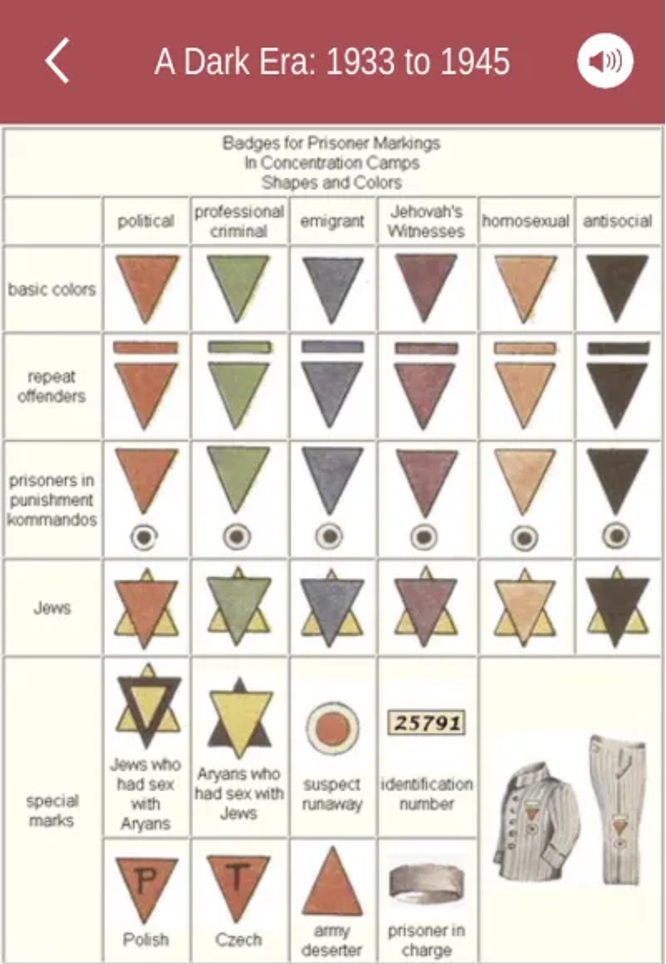
The image above displays the different identification badges that would be worn in the camps. The purple triangle was used primarily for Jehovah’s witnesses since they comprised over 99% of those who were given this badge; however, there were also members of small religious groups who were also made to wear this badge. The pink triangle was mainly used to label homosexual prisoners, however, it applied to sexual offenders, as well. “Antisocial” in this context applied to a wide array of prisoners. The black triangle was forced onto those who were considered “asocial elements,” such as the mentally ill, the disabled, drug addicts, prostitutes, beggars, alcoholics, and Roma. If there was a single triangle badge placed on top of a yellow triangle (forming a star), the person made to wear it was of Jewish faith.
The prisoners were further divided amongst themselves into two distinct categories. The Holocaust survivor Primo Levi, in his memoir Survival in Auschwitz, explains that there was a division of prisoners: “the drowned” and “the saved” (Levi 87). The drowned were known as the “musselmans, the men in decay… only here on a visit… in a few weeks nothing will remain of them but a handful of ashes in some near-by field and a crossed-out number on a register. They suffer and drag themselves along in an opaque intimate solitude, and in solitude they die or disappear, without leaving a trace in anyone’s memory” (Levi 89). Levi refers to them as “non-men… already too empty to really suffer” and they made up the majority of the prisoners, or, as he calls them, the “anomalous mass” of the camp (Levi 90). In contrast, the “saved,” or the “prominents,” were the camp officials, and those who “fight merely with their own strength to survive” (Levi 92).
Arrival
In his short story “This Way for the Gas, Ladies and Gentlemen,”Polish Auschwitz survivor Tadeusz Borowski provides a first hand eye witness account of an arrival of deportees onto the railway platform at Auschwitz. It was considered a privilege for a prisoner to be permitted to accompany the SS guards to the arrivals because the prisoners were allowed to take some of the resources (mainly food) that the deportees had brought with them. But terrible images burn in Borowski’s mind:
The morbid procession streams on and on—trucks growl like mad dogs. I shut my eyes tight, but I can still see corpses dragged from the train, trampled infants, cripples piled on top of the dead, wave after wave . . . freight cars roll in, the heaps of clothing, suitcases and bundles grow, people climb out, look at the sun, take a few breaths, beg for water, get into the trucks, drive away. And again freight cars roll in, again people . . . The scenes become confused in my mind—I am not sure if all of this is actually happening, or if I am dreaming. There is a humming inside my head; I feel that I must vomit
Borowski, p. 9
Deportees were divided into two groups: those who were fit to work and those who were not. Many women and children, along with the old and the dead, were typically sent to the gas chambers whereas many of the men, if they seemed strong enough to work, were sent to the camp.
Prisoners who were not sent to the gas chambers would be given serial numbers which were tattooed onto them, and these numbers served as replacements for individuals’ names. The same needle was used to tattoo every prisoner, which led to the spread of disease. The tattoos were placed on the prisoners’ left forearms, and in Auschwitz this number was sewn onto the uniform in a particular spot.
What’s your name?’ My name was Tova. She said ‘no. From now on, it’s 27,633.
TOva Friedman, one of the youngest survivors of Auschwitz
Tattoos were first given to Soviet prisoners of war beginning on October 1941. Spring of 1942 was when the SS started systematically tattooing incoming Jewish prisoners. This also applied to sick prisoners who were transferred from the camp hospital to the new Birkenau camp. In early 1943, the Camp Commandant’s Office decided to give all incoming prisoners tattoos.
Tova Friedman, one of the youngest survivors of Auschwitz, recounted the time she received her tattoo. She particularly remembered the conversation she had with the tattooist: “‘What’s your name?’ My name was Tova. She said ‘no. From now on, it’s 27,633.’” Tova emphasized that she “didn’t know what numbers were, [she] didn’t know what thousands were,” but she knew that her life depended on knowing her number.
What Did Prisoners do? Labor in the Camps
The Nazi camps had an extensive prison labor system, designed not only to help the Nazi war effort but also to ensure divisions between prisoners and to keep them from group action. The vast majority of prisoners were manual laborers, but Nazis also used prison labor to control other prisoners, operate the crematoria, perform specialist roles, and even play in an orchestra.
Manual Labor
The vast majority of prisoners worked as manual laborers. Due to the physical strain, most of these workers died, which was ultimately the Nazi regime’s goal: the idea was “‘annihilation through work’” for almost all of the prisoners. Manual labor consisted of many hours of exhausting work while running on little sleep and nutrition. Forced labor included, but was not limited to, building and repairing, coal mining, heavy lifting (including stones). The prisoners worked in terrible conditions, and had to constantly take beatings from their cruel supervivors who beat them at every wrongdoing.
Kapos
Within the camps, Nazis assigned some prisoners positions of authority. This was done to establish a system of prison functionaries. One position is referred to as a Kapo. Kapos, who were essentially prisoner-supervisors, had some level of power. Other benefits, aside from authority, also came with being a Kapo. They were typically given preferential treatment, like extra rations, and they often didn’t have to perform hard labor. Many times, they were also given cleaner and larger sleeping spaces.
Since Kapos worked directly under the SS, it was mandatory that they report to them daily. If they failed to do this, they would promptly be removed from their post. Additionally, since they were in a position of authority, they were often disliked by other prisoners since they were responsible for punishing them and informing SS about issues.
The three main types of Kapos were work supervisors, block elders, and camp administrators. Work supervisors were responsible for overseeing the prisoners at work. They made sure that work was being completed efficiently and that nobody escaped. Block elders made sure that prisoners kept the barracks clean. For example, they ensured that beds were made. They were also responsible for getting roll calls on time. In addition to this, they were also tasked with counting prisoners and accounting those who had died or were ill as well as handing out the food. Camp administrators were responsible for other miscellaneous jobs such as supervising work done in the kitchen and the storeroom. Sometimes they would even work as secretaries and interpreters.
Sonderkommando
Though no position was good, the lives of Sonderkommando were especially bleak. Sonderkommando were groups of, generally young and healthy, Jewish male prisoners who were mainly responsible for disposing the corpses of gassed victims. Sonderkommando instructed arrivals (specifically those who were selected to be gasses) to undress and arrange their clothing in a certain way. Once the gassing was complete, they separated the bodies and cleaned/ventilated the chambers. The victim’s bodies would be brought to the crematorium level, where another group of Sonderkommando would shave them and search for valuables. If any were found, they would be handed over to the SS. After this, the Sonderkommando would burn the bodies and dispose of the ashes.
How can you, somebody, be able to survive in such an environment?
Dario Gabbai, Sonderkommando survivor
Part of the reason as to why Sonderkommando were used was to prevent SS personnel from having to witness the more disturbing aspects of mass murder. Due to their position, Sonderkommando knew the most about the “Final Solution.” Because of this, they were forbidden from warning new arrivals of their fate. They were also often completely separated from other prisoners and kept in either the gas chamber complex or in separate barracks. Their days in this position were also numbered, and their fate was no better than the corpses they disposed of. Being a Sonderkommando was a death sentence. After a few months of working at the gas chambers, Sonderkommandos were killed and rotated out.
Additionally, due to seeing many of the horrors of mass murder, Sonderkommandos were known for their resistance efforts. Some managed to sneak photos of the crematoria and gas chambers while others participated in armed revolts. One famous revolt took place at Auschwitz in October 1944. During this time, the Sonderkommando of all four main crematoria decided to revolt, and in the aftermath, crematorium IV was destroyed. Some sonderkommando members of Crematorium III were surprisingly able to escape briefly.
Dario Gabbai, a Jewish survivor of the Holocaust, was notable for his roll as a Sonderkommando at Auschwitz. Life as a Sonderkommando was both physically and emotionally miserable. “When — after 15-20 minutes — they open up the [doors to the gas chamber], the first thing I see — I saw the people I saw 15 minutes before alive. I saw the mothers with the children… and when you see that after — some are black and blue from the gas — it’s something that I said to myself ‘how can you, somebody, be able to survive in such an environment?’”
Specialists
A better work assignment, as a specialist, for example, helped prisoners to survive. This is an example of where being both lucky and having a useful skill was crucial for survival in the concentration camp. Specialists reaped the benefits of working indoors and escaping the freezing cold winters, they got slightly more to eat during the day, and they did not have to push their bodies to the breaking point every day. Specialists were also not beaten and treated terribly because they were in more dignified settings. That likely also helped them to regain a sense of humanity.
Levi, at first, worked as a manual laborer, but because of his background as a chemist, he was later selected to work in Auschwitz’s laboratory. Levi recognized his “gift of fortune” when he was chosen to work as a chemical specialist:
…we entered the Laboratory timid, suspicious and bewildered like three wild beasts slinking into a large city… for a moment the large semi dark room at the university, my fourth year, the mild air of May in Italy comes back to me with brutal violence… so it would seem that fate, by a new unsuspected path, has arranged that we three, the object of envy of all the ten thousand condemned, suffer neither hunger nor cold this winter. This means a strong probability of not falling seriously ill, of not being frozen, of overcoming the selections.
Primo Levi, p. 139-40
Orchestra
Another form of labor, which one might not expect to find in the camp, was the orchestra. There was an orchestra in nearly every camp, and the orchestra was made up of both professional and amateur musicians. The other inmates were expected to march in sync with the orchestra’s beat when going to and coming back from manual labor. Jewish survivor Anita Lasker-Wallfisch, gave a survivor testimony in which she explained her role as a member of the camp’s orchestra.
In her testimony, Lasker-Wallfisch explained that she was very “privileged” because while the men’s orchestra in Birkenau had to go and do manual labour during the day, the women’s orchestra of Auschwitz would go back and rehearse. She explained that about 40 people played in the orchestra, and about five or six wrote the music. In addition to playing for Nazi holidays and for camp inspections, which perhaps was a way for the supervisors to show off their prestige, the orchestra played during executions. Arguably the most twisted of the orchestra’s duties, was being forced to perform for the newly arrived prisoners who were about to be gassed; the SS did this to deceive and calm the doomed. However, not all of the orchestra’s performances were public: sometimes the orchestra had to perform unofficially for guards.
What was Daily Life Like in the Camp?
Every aspect of life in the camp was horrible and dehumanizing for the prisoners: the journey to the camp, the lack of hygiene in the camp, the terrible sleeping arrangements, the never-ending exhausting labor, the beatings, and the severe lack of food. Levi explains the dehumanization that he witnessed around him:
to destroy a man is difficult, almost as difficult as to create one: it has not been easy, nor quick, but you Germans have succeeded. Here we are, docile under your gaze; from our side you have nothing more to fear; no acts of violence, no words of defiance, not even a look of judgement.
Levi, p. 150.
Order
Inmates were expected to follow precise rules about cleanliness. It was prohibited to sleep with one’s jacket on, without one’s pants on, or wearing one’s hat; not to shower on one’s assigned day; to leave the barrack without one’s jacket being buttoned or the collar raised; to place paper or straw under one’s clothes to protect one from the cold; and to have mud stains on one’s uniform (Levi 34).
Sanitation
Although the Nazis valued order and tidiness, such as cleanly made beds, living spaces in the concentration camps were by no means sanitary. The prisoners who were not sent to the gas chambers were disinfected upon arrival. This either meant a lysol dip or using brushes on each prisoner. Uniforms were never washed. They were disinfected by steaming every six to eight weeks, and, although prisoners were checked for lice and skin rashes, the spread of diseases was still rampant due to lack of hygiene and overcrowding. Prisoners also had to be cleanly shaved, but because the entire barrack used the same razor, barber’s rash was a frequent problem. Prisoners were expected to shower once a week, but they got soap only once a month, and, although one would immediately get dirty again, it was required.
The latrines in the camps were also very unsanitary. Although it likely varied from camp to camp, there were not nearly enough latrines for each prisoner. There were only three latrines for about every 500 prisoners in Ravensbruck. Instead of using the latrines at night, inmates would use a bucket in the barrack to relieve themselves, and the last person who used the bucket had to dump it out. However, it was nearly impossible to carry the bucket steadily so the bucket’s contents would usually spill out onto the person who was carrying the bucket (Levi 62).
Sleeping Conditions
Sleeping conditions in concentration camps were terrible. They were very overcrowded and far beyond uncomfortable. Prisoners slept in cramped, wooden barracks with thin mattresses, if they had any at all. Levi recalls sharing a bunkmate, and it being a necessity to sleep head to toe, otherwise the two prisoners would not fit. They would sleep on thin straw mattresses, and would share a blanket with their bunkmate (Levi 58, 56). Sleeping conditions in the all-women’s concentration camp Ravensbruck were arguably worse. The camp was so overcrowded that barracks that were meant to house 250, housed 1,500-2,000, in which some women had to sleep on the floor without a blanket.
Not all barracks were completely divided by gender. At Auschwitz, there was a separate section of the camp for the Roma, known as the Terezín Family camp, and in Auschwitz II there was the “Gypsy Camp,” in which families were allowed to stay together. There was terrible overcrowding in these camps. In some cases, in the “Gypsy Camp” barracks, 15 people would be sleeping in a bunk that was 185 centimeters long and 280 centimeters wide.
Work and Roll Call
Prisoners worked when it was light out. This meant that they worked very long days in the summers, and shorter days in the winters. Prisoners were awakened at 4:00 am for roll call, which could take hours depending upon the number of prisoners. Roll calls were known to be brutal times of day during which many people died. A survivor from Eugène Aroneanu’s collection of Holocaust survivor stories writes, “Three times I had to prop up dead bodies at roll call. Finally, I told an SS guard that this didn’t make any sense. His answer was: ‘Dead or alive, everybody has to be there.’” (Aroneanu 42).
This quotation from the SS guard speaks both to the terrors of roll call, and to the importance of order to the Nazis. Prisoners had to make their beds, use the latrines (of which there were not nearly enough for the number of prisoners), and be on time for roll call, or else they were severely beaten. After roll call, prisoners would be given breakfast. Then, they would head off to their respective work. After work, prisoners had roll call and were fed dinner, after which they went to sleep.
Nutrition
As the war went on, resources became scarce and the prisoners’ food was rationed out so that they were fed less and less and the quality of food and nutrition level also deteriorated. Meals consisted mostly of coffee in the morning, and soup. Although it likely varied camp by camp, it appears as though prisoners’ meals typically consisted of coffee in the morning for breakfast, soup for lunch and dinner, and bread once or twice a day. Inmates were always starving as they never received a sufficient amount of food, especially for those who were doing hard manual labor (almost the entirety of the camp population) whose bodies required an even higher calorie intake. The water in the camps was also undrinkable because it was contaminated. Instead, prisoners had to rely on coffee and soup to keep them hydrated.
Hospitals
Many concentration camps, such as Flossenburg and Auschwitz, had camp hospitals. While those with minimal injuries often received treatment (since they were a valuable source of labor) many critical patients did not receive the care they needed. In fact, prisoners often referred to the infirmaries as waiting rooms for the crematorium. This is due to the lack of essential medicines and general medical negligence. Patients who were considered weak and unlikely to recover quickly were often killed by either lethal injection or gassing. Additionally, in Auschwitz-Birkenau, the hospital was often a site of medical experimentation that typically led to patient death or permanent injury.
Death in the Camp
The Nazis had various methods for killing in the camps: gassing, hanging, and shooting. The different methods used depended mostly upon both the scenario, whether it be a punishment for a crime or a selection, and the time period. Others died from exhaustion, starvation, and disease. One of the survivors from Aroneanu’s compilation commented, “In reality, we were all sentenced to death. Only the interest the Germans had in our work gave us a stay of execution. All of us awaited the day when we would die of total exhaustion or suffocation in a boxcar or gas chamber or by some other means of extermination (Aroneanu 59).”
Gassing
One of the most well known methods of killing was gassing. Before the Nazis built the gas chambers, they tested gassing through mobile gas vans. These vans were first deployed in 1940 during euthanasia operations. Prior to being gassed, victims would be commanded to undress and hand over their valuables. Once this was done, they entered the gas vans and the two doors at the back of the wagon were shut. The exhaust was then blocked which caused carbon monoxide to leak into the van. Eventually, those in the van died from suffocation. Once they passed, their bodies were brought to a cremation site.
In 1942, three extermination camps with stationary gas chambers were built as a part of Aktion Reinhard. Aktion Reinhard was the program established to eliminate Jews in the Generalgouvernement. Belzec began operation in march. It had three gas chambers. Sobibor began killings in May. Treblinka was established in July and also had three gas chambers. Fall of 1942, Nazis expanded these gas chambers and opened new ones. At these camps, Nazis used carbon monoxide gas, created by diesel engines, in their chambers. The Nazi’s gassing method at Auschwitz was more effective. There, Nazis used “Cyclone B solution, [as] an efficient killer of lice in clothing and of men in gas chambers,” (Borowski 1).
Cyclone B, also referred to as Zyklon B, proved to be a quicker gassing method. Before entering the chambers, victims were told to strip and hand over possessions and that they needed to be disinfected in “showers.” Similarly to the vans, the victims would die from suffocation. SS would often try to pack in as many people as possible since more people caused the suffocation process to speed up. Auschwitz alone had five crematoria. A main Nazi goal was eliminating as many prisoners as possible in the shortest amount of time. Henryk Tauber was a member of the Sonderkommando at Birkenau’s gas chambers. After the war, he stated, “on average, we incinerated 2,500 bodies a day.”
Hangings
The Nazis also performed individual killings, such as hangings. Hangings appear to have been used as a way to punish people for individual acts: they were not a method used in camps to mass-murder. Hangings were used as punishment for sabotage, stealing from the kitchen, and failed attempts to escape the camp. One of the most well-known hangings took place on July 19, 1943 when 12 prisoners were hanged for an attempted escape in which three in their group had succeeded. Hangings were public, and occurred during roll call: a time when the prisoners were guaranteed to all be in the same place. Hangings were essentially a fear-instilling spectacle used to keep the prisoners in order. The public, and therefore somewhat special, nature of the hangings may have had somewhat of the opposite effect that the Nazis would have wanted on their prisoners. When describing a hanging scene that he witnessed, Levi explains that “perhaps the Germans do not understand that his solitary death, this man’s death which has been reserved for him, will bring him glory, not infamy” (Levi 149).
Shooting
Shooting appears to have been less common of a practice for mass murder in concentration camps than gasing. Prior to 1941 (when gas chambers were built in Auschwitz), people were shot and killed near the camp in dug-up gravel pits, which the prisoners were often forced to dig themselves. But, from the fall of 1941-1943, mass shootings took place inside Auschwitz at Block 11 in front of what was named the “Death Wall.” The condemned, as was customary for all of the other methods of killing, had to undress completely, and would be shot in the back of the head with a small caliber rifle.
Most of the people who were shot in front of the Death Wall were Poles who received special death sentences by shooting. Nazis at Dachau concentration camp also mass murdered prisoners through shooting. Hebertshausen shooting range was an SS shooting range about two kilometers from Dachau, and started being used as a place to execute prisoners in 1941. In addition to being used to execute Soviet Prisoners of war immediately after arrival at Dachau concentration camp, the shooting range, similar to Auschwitz’s Death Wall, was used to kill those sentenced to death by the SS and Police Courts.
Selection
The ‘selection’ in the Holocaust refers to the process of deciding who will be sent for labor and who will be killed. After the deportation train arrived, men were separated from women, and Nazi doctors and commandants would assess factors such as age, physical capability, skills, etc. This was to see who would be in the best health to provide work.
An officer would direct a prisoner to either their left or right with no explanation. One side was for the camp, the other was for the chamber. Those who were not selected to die were then stripped of their clothes and their valuables were taken away. Once this was done, they were shaved of all their hair, disinfected, and showered. After this, they were tattooed with a registration number (however, it is important to note that only prisoners at Auschwitz received tattoos).
They were then handed new clothes and sent off to the camps. The type of people that were typically sent to gas chambers are as follows: pregnant women, the mentally and physically disabled, the sick, children under the age of 16 (later brought down to 14 in 1944), and the elderly. Borowski describes how “several other men are carrying a small girl with only one leg. They hold her by the arms and the one leg. Tears are running down her face and she whispers faintly: ‘Sir, it hurts, it hurts . . .’ They throw her on the truck on top of the corpses. She will burn alive along with them” (Borowski 12).
Death in the barracks
In addition to the forms of extermination described above, prisoners would also die from exhaustion, starvation, and diseases either while working or in their sleep. In her testimony, Lasker-Wallfisch explains how at Bergen-Belsen Concentration Camp, those who died in the barracks would be “chuck[ed] out.” She explains, “we lived among heaps of bodies…the stench of the bodies lying there and decomposing…it was meaningless to us, a dead body by that time, totally meaningless. Heaps of them there, heaps of them there.”
Survival Rates
The survival rates for the camps varied widely depending largely on whether the camp was a concentration camp or a death camp. The following are some of the survival rates for the more concentration camps: 69% for Flossenburg and 79.25% for Dachau. The following are the survival rates for death camps: 0.01% for Treblinka, 0.005% for Chelmno, and 0.03% for Sobibor. For Auschwitz, a mixed forced labor and death camp, the survival rate was 15%.
Medical Experiments
Nazi camps were the site of medical experiments, as well. For example, twins would often be taken to be medically experimented on. An infamous example of this can be seen with Josef Mengele, who led a program that experimented on about 3,000 children at Auschwitz-Brikenau. During these experiments, he would expose the twins to diseases, disfigure them, and torture them. One twin was usually used as a control while the other was the subject of experimentation. The twin that died was dissected and studied while the other was killed and subjected to the same analysis.
One survivor of Mengele’s twin experiments was Eva Kor. Life as a Mengele twin was miserable. “In our barrack, we, the children, huddled in our filthy beds crawling with lice and rats. We were starved for food, starved for human kindness and starved for the love of the mothers we once had. We had no rights… No one explained anything to us nor did anyone try to minimize the risks to our lives. On the contrary, we knew we were there to be subjects of experiments and were totally at the mercy of the Nazi doctors. Our lives depended entirely on the doctors’ whims.” At the age of 10, Kor became a human guinea pig. After receiving an injection, Eva became very sick and was sent to the camp hospital. At this hospital, she received no care. Despite the odds, she survived and was reunited with her sister, Miriam. Eva emphasized that, had she died, “Mengele would have killed Miriam with an injection to the heart and would have done comparative autopsies on [their] bodies.”
From March-August 1942, experiments were conducted at Dachau to test the limits of human endurance at high altitudes. These experiments were carried out “for the benefit” of the German Air Force. These tests took place in a low-pressure chamber where the atmospheric conditions reached altitudes of up to 68,000 feet. Most victims died from the conditions, and those who did survive often suffered injury related to the high atmospheric conditions.
Another experiment at Dachau took place from July-September 1944. This test studied the viability of making sea water drinkable. The test subjects were deprived of food and given chemically processed sea water. The aftermath was excruciating, causing great pain, extreme dehydration, and organ failure.
For Further Reading and Research
- Aroneanu, Eugène, editor. Inside the Concentration Camps: Eyewitness Accounts of Life in Hitler’s Death Camps. Westport: Praege. 1996
- Borowski, Tadeusz. This Way for the Gas, Ladies and Gentlemen, and other stories. New York: Penguin Books, 1967.
- Browning, Christopher R. Remembering Survival: Inside a Nazi Slave-Labor Camp. New York: W.W. Norton & Co., 2010.
- Geise, Nancy. Auschwitz #34207: the Joe Rubinstein Story. Merry Dissonance Press, 2015.
- Gelissen, Rena Kornreich. Rena’s Promise: A Story of Sisters in Auschwitz. Boston, USA: Beacon Press, 2018.
- Gutman, Israel., and Michael Berenbaum. Anatomy of the Auschwitz Death Camp. Bloomington: Indiana University Press, 1994.
- Halpin, Ross W. Jewish Doctors and the Holocaust : the Anatomy of Survival in Auschwitz. Berlin : De Gruyter Oldenbourg, 2018.
- Heger, Heinz, and Klaus Muller. The Men with the Pink Triangle: The True Life-and-Death Story of Homosexuals in the Nazi Death Camps. Translated by David Fernbach. Boston: Alyson Books. 1994.
- Herz, Gabriele. The Women’s Camp in Moringen: A Memoir of Imprisonment in Germany, 1936-1937. New York: Berghahn Books, 2006.
- Kor, Eva Mozes, and Lisa Rojany-Buccieri. The Twins of Auschwitz: the Inspiring True Story of a Young Girl Surviving Mengele’s Hell. Monoray, 2020.
- Kor, Eva Mozes, and Mary Wright. Echoes from Auschwitz: Dr. Mengele’s Twins; the Story of Eva and Miriam Mozes. Terre Haute: Candles, 2002.
- Lengyel, Olga. Five Chimneys. Chicago: Academy Chicago Publishers, 1995.
- Levi, Primo. Survival In Auschwitz. Translated by Stuart Woolf. Reprint Edition. New York: Simon & Schuster. 1996.
- Müller, Filip. Eyewitness Auschwitz: Three Years in the Gas Chambers. Chicago: I.R. Dee, 1999.
- Neurath, Paul Martin. The Society of Terror: Inside the Dachau and Buchenwald Concentration Camp. Boulder, CO: Paradigm Publishers, 2005.
- Sofsky, Wolfgang. The Order of Terror: The Concentration Camp. Princeton, NJ: Princeton University Press, 1997.
- Todorov, Tzvetan. Facing the Extreme: Moral Life in the Concentration Camps. New York: Metropolitan Books, 1996.
- Vrba, Rudolf. Escape from Auschwitz: I Cannot Forgive. New York: Grove Press, 1986.
- Vrba, Rudolf and Alfred Wetzler. The Wetzler-Vrba Report.
- Wiesel, Elie, and Marion Wiesel. Night. New York, NY: Hill and Wang, 2006.
