Welcome to “Holocaust History at Davidson,” designed by Professor McQuinn’s Fall 2020 HIS 234 class!
This site is designed to be a primer on major issues in Holocaust history, including historical debates, issues, and source materials. Each page includes a description of the issues, and then an insight into the kinds of sources you can use to learn more about that issue. We hope that you will integrate elements of this site for your classes and your projects; each page should help you navigate materials available online and at the Davidson College Library.
Why study the Holocaust?
From students in HIS 234:
“I believe it is especially important to study the Holocaust as the last generation of survivors are passing on. For many years, survivors recounted their stories in oral histories or written testimonies. Now, it is up to us to keep alive the memory of those who fell victim to Nazi persecution. We must continue to educate children in schools and learn more about the lives of those who experienced the Holocaust. If we fail in this endeavor, the lessons we could learn from the Holocaust will be forgotten, and it will become only a paragraph in a history textbook.” – Jonah Pesikoff, Davidson ’23
“The Holocaust is a foundational historical event of our time, and for good reason — it an extreme event in history that had massive consequences for Europe and the world. It is, however, often remembered by generalizations simplifying it down to Nazis and Jews, camps and hiding. The Holocaust should be studied to learn about its profound nature: it is comprised of vast and diverse accounts, perspectives, and experiences. The well-known narratives of perpetrator, bystander, and victim are not as clear cut or simple as they appear to be on the surface, and when the subject is explored in more depth, the layers and complexity of humanity and studying history itself are revealed.” – Addie Anderson, Davidson ’24
Didn’t we learn about the Holocaust in school already?
According to the 2020 Claims’ Conference Survey, Holocaust awareness is at a disturbing low level among Gen Z-ers. HIS 234 set out to determine whether Davidson College students were above their peers. 90% of our respondents report studying the Holocaust before Davidson, while only 14% studied the Holocaust at Davidson. Thus, our study primarily identified whether pre-college education was effective at teaching students about the Holocaust.
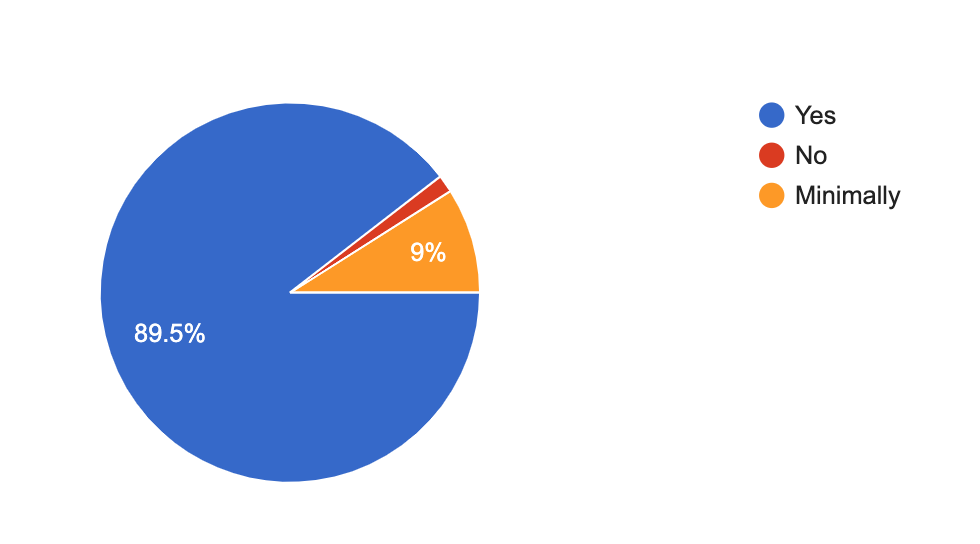
The number of students who studied the Holocaust before Davidson 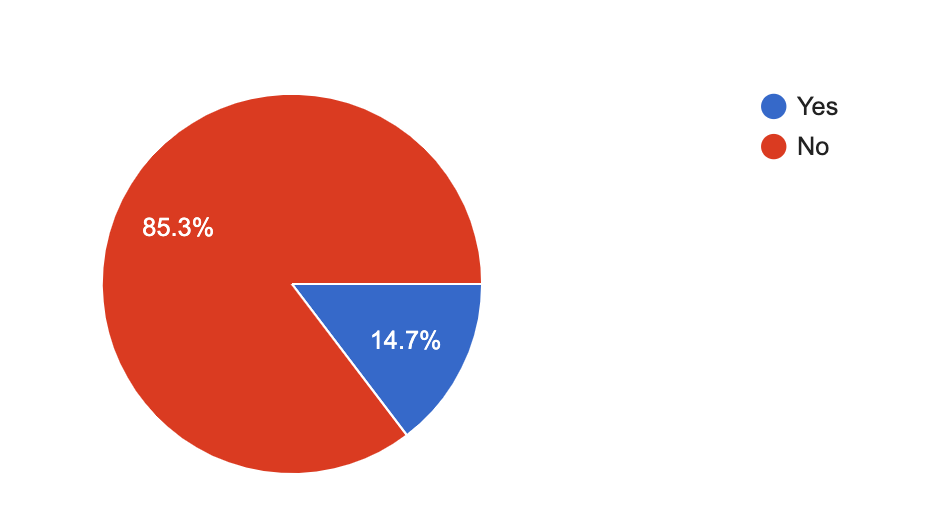
The number of students who studied the Holocaust at Davidson
This is what we found.
- Davidson College students have much higher levels of basic Holocaust facts than the average Gen Z.
- Over 75% can identify when the Holocaust took place and how Hitler came to power.
- 80% know that 6 million Jews were murdered in the Holocaust and can identify Auschwitz. Nearly 98% are aware that the Nazis committed genocide against other groups.
- After these basics, our results indicate a number of interesting observations about pre-college Holocaust education.
On Resistance:
- 75% of students were able to list a way that Jews resisted deportation. However, the responses suggest some interesting insights into the ways that students are taught to think about resistance to persecution.
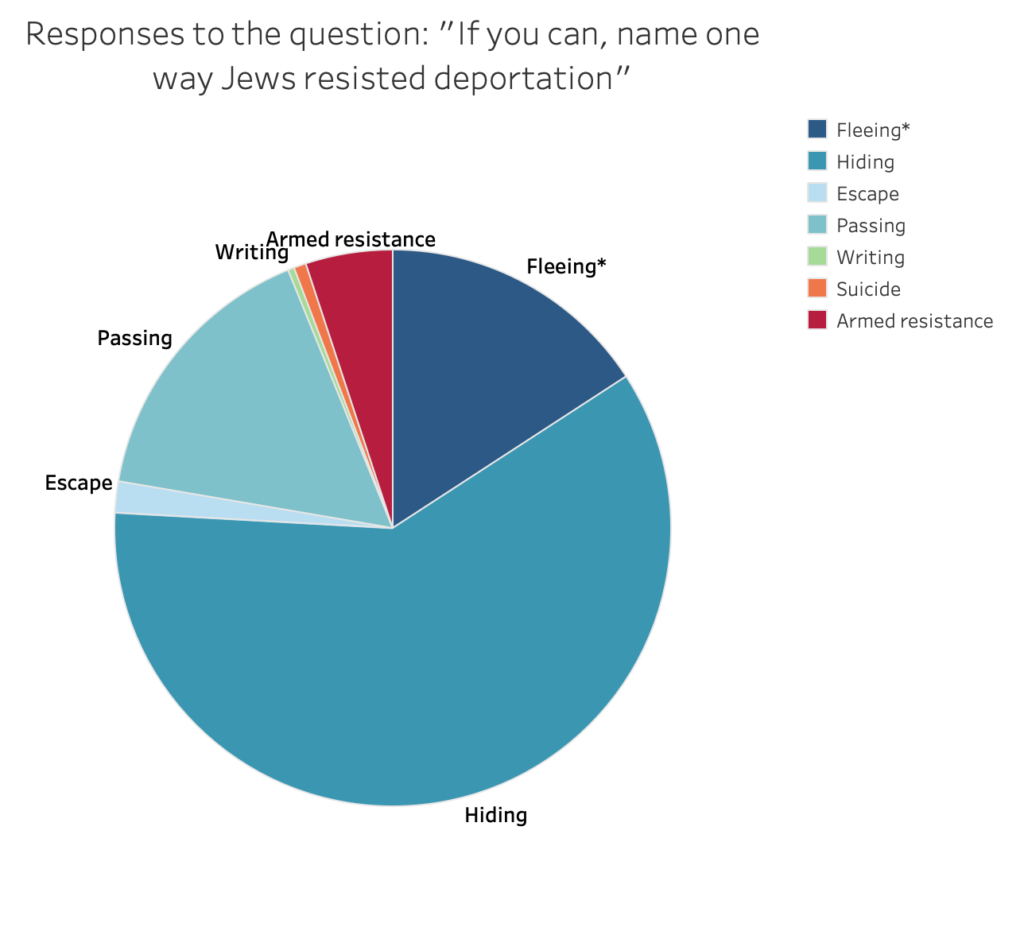
- A relatively high number of students (nearly 16%) put fleeing, which we categorized as attempts at emigration, as a way that Jews escaped deportation. We distinguished this from acts of escape from a concentration camp, ghetto, or train. Emigration was a prominent mode that Jews attempted to escape life under Nazi occupation before World War II. By the time Jews were deported in mass to concentration and death camps, emigration had in fact become extremely difficult, and nearly impossible for Jews living in Eastern Europe. Learn more about refugee experiences.
- What this suggests is that students know very little about the difference between escaping Nazism and escaping genocide – while Nazism was antisemitic, racist, and prejudicial from the outset, policies of systematic mass murder (and the deportations that facilitated them) did not begin until 1941. References to Albert Einstein[1] and Henry Kissinger as Holocaust survivors, both of whom fled Nazism before the war, reaffirms the likelihood that students are taught little about how racist rhetoric and policies became genocidal.
- By far, the most common responses were forms of resistance that involved survival by removing themselves from public space, especially as Jews. Frequently, student responses explicitly referenced the help of kindly neighbors.
- What this suggests is that American education systems prefer to emphasize victims of racism as total and complete victims – that is to say, that American education systems are uncomfortable portraying victims of violent racism as anything but helpless. The reality was Jews mostly had to find ways to help themselves, and even hiding and passing often required forms of bribery. Moreover, these responses suggests that by painting victims as martyrs, American education systems deprive Jews of the forms of agency they mobilized under conditions extreme persecution: in addition to bribery, these included black marketeering, smuggling, theft, underground (and illegal) networks, and even sexual barter.
- Only 4% of students named armed resistance as a mode of resistance to deportation, even though several ghettos and camps were the site of violent uprisings, and many Jews joined partisan movements in the Soviet borderlands. The low level of recognition of armed and violent resistance underscores the likelihood that American students are implicitly taught that there is a “proper” way to resist violent racism. Read more about Jewish Partisans and armed uprisings.
- The fact that American education neglects to address the roles that Jews played in their own survival and resistance has larger implications beyond the study of the Holocaust. American Holocaust education seems to have confined the victim or survivor to a narrowly prescribed set of appropriate behaviors: in order to be a victim, one must be able to claim pure innocence. Their acts of survival must be facilitated by the peaceful goodwill of others, rather than to resort to modes of self-help that might be seen as less scrupulous – but were in fact often necessary for survival.
On Survivors:
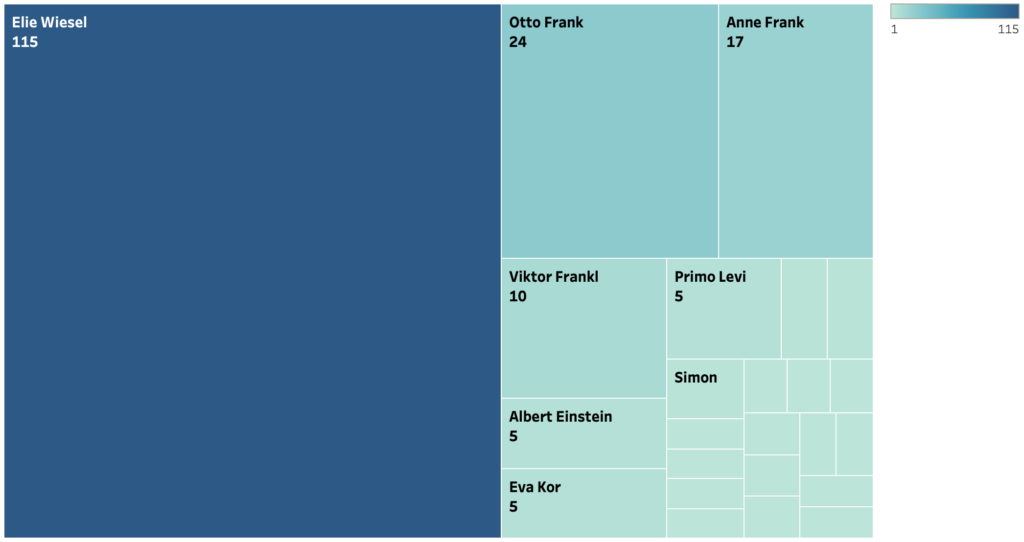
- Fewer than 50% could identify a Holocaust survivor. Having studied the Holocaust before Davidson only improved the chances that a student could name a Holocaust survivor by 5%. This suggests that pre-college Holocaust education is taught primarily from the perspective of perpetrators or major events. Having taken a college level course in the Holocaust, by contrast, nearly doubled the likelihood that a student would name a survivor.

- Over half of students who could name a survivor listed Elie Wiesel. The next most prominent reference was to Otto Frank, Anne Frank’s father. Disturbingly, of the 201 responses to this question, nearly 10% listed Anne Frank, who died during the Holocaust, as a survivor. The high number of references to Anne Frank or her father, combined with the prominence of “Hiding” (60% of responses) in the list of modes of resistance to deportation, suggests that many students get their basic Holocaust knowledge from the Diary of Anne Frank.
On America’s Relationship to Nazism:
- Students appear to be taught the least about the global response and discovery of the Holocaust. Students have an inflated sense of the American interaction with the spaces of atrocities. Though the US Army was responsible for discovering the German concentration and labor camps within Nazi Germany, all of the ghettos, death camps, and locations of mass murder in Europe were discovered by the Soviet Union.
- Fewer than 40% were able to correctly state whether the US ever mounted a rescue effort for victims of genocide during the war. (Although it was discussed with the founding of the War Refugee Board, the US never put forth any official efforts to save victims of genocide).
- Read more about America’s relationship to Nazism on our page “Nazism in Global Context.“
[1] Einstein, in fact, never even lived in Nazi Germany; he was in the US when the Nazis came to power, and he never returned because of the anti-semitic nature of the Nazi regime.
