By Ruby Zhou ’24 and Natalie Bivens ’24
As the Nazis continued deporting and killing Jews in large waves during the Holocaust, it became increasingly clear that the goal of the Nazi regime was to exterminate the Jewish population. Though it was apparent that Jews’ attempts at resistance would not eliminate anti-Jewish policy and violence, the Jews focused on individual survival and believed that even small efforts were worthwhile. Some Jews hoped to survive and eventually escape, while others believed their deaths were unavoidable and hoped to die in one last act of bravery. They participated in several forms of resistance in order to oppose Nazi persecution: hiding, passing, and armed resistance. Studying this resistance as a component of Holocaust historiography provides diverse experiences which help develop a broader context to this period of history.
Hiding
As the Nazis began producing deportation lists, many Jews who did not want to go with the others to concentration camps decided to find a place where they could hide and avoid Nazi persecution. To escape deportation and death, Jews hid in different places, such as cellars, attics, pits, forests, and sewers. Nearly always, hiding in a tight space for a long period of time with little to do caused a psychological toll on a person’s health as well as a physical one. Usually the fugitive Jews could barely move or make noise during the daytime, and they often endured brutal temperatures and unrelenting hunger. They had no choice but to rely on their rescuers completely, knowing that one mistake or change of heart could lead to their discovery and probable death.
Not only was hiding a great risk for the Jews, but it was also a danger to their rescuers who allowed them to stay, provided food, and were willing to risk their lives for the chance of saving others.
Though these rescuers were right in their decision to shelter the Jews in hiding, oftentimes their “generosity” required something in return. Due to labor shortages, poor, non-Jewish people would give room and board in exchange for money or labor. It was not uncommon for rescuers to hold anti-Semitic views, but usually they disregarded this prejudice for the sake of their own benefit or survival. However, the decision to hide Jews remained a controversial subject between family members.
The House of Ashes by Oscar Pinkus describes the experiences of a Jewish family that lived in a farmer’s barn in a small pit for five years. During these years, the Jews were afraid; the farmer’s wife constantly demanded that her husband force the Jews away. However, the farmer refused, continuing to “lose” the Jews’ possessions and declining to improve the conditions of their shelter without payment. The entrance to the pit was camouflaged with manure, and there was only enough space for the adults to sit up, while the children could stretch their legs. They endured extreme heat, hunger, and the distress of living with bedbugs and rats.
The experiences of this Jewish family were typical of many. Other families often split apart and went separate ways, especially if they could leave their children with a non-Jew who was able to “adopt” them in secret. This also occurred if a space was not large enough; however, there were some hiding places which could hold a significant number of people. One such hiding place was the Krysia bunker, located underneath a greenhouse outside of the Warsaw Ghetto.
This greenhouse, which housed Jews from 1942 to March of 1944, belonged to the Polish Wolski family. After hiding one Jewish girl in their house for a month, the Wolski’s received a proposal from the Jewish Social Self-Help organization to build a bunker under the greenhouse for Jews to stay as they were smuggled out of the Warsaw Ghetto. The number of Jews who lived in the Krysia bunker grew to about forty people. Though these Jews were cramped hiding in one underground bunker, they managed to have more space than most Jews who lived in similar hiding places, and they were able to have light, running water, tables, beds, and a cooker.
In order to disguise abnormal purchases of food for the Jews, the Wolski family opened a grocery store at their home. Some of the costs of operating the bunker were paid by a Polish underground organization called Żegota, while the remaining costs were paid by the hiding Jews themselves. Each Jew paid 10,000 zlotys to the Wolski family upon arrival as well as additional regular payments. Due to these expenses, those who lived in the Krysia bunker were mainly wealthy Jews.
One of these Jews was Emanuel Ringelblum, Polish-Jewish historian who founded the Oyneg Shabes Archive, which is a record of experiences within the Warsaw Ghetto in Nazi-occupied Poland. Another Jew who took shelter in the Krysia bunker was Orna Jagur, author of The Hiding Place, in which she gives an account of life and death in the bunker. Jagur wrote:
At one of the tables, always at the same place, a quiet middle-aged man (…) was writing nearly all the time, through entire days and evenings, spending hours by the table full of papers and books. (…) Dr. Ringelblum was only physically present in the Krysia bunker; his thoughts were far away from there. He didn’t take part in the daily life, remaining unmoved in the moments of fear as well as relief. He didn’t participate, didn’t take part in discussions or arguments.
Orna Jagur, „Krysia” bunker, p. 33-4.
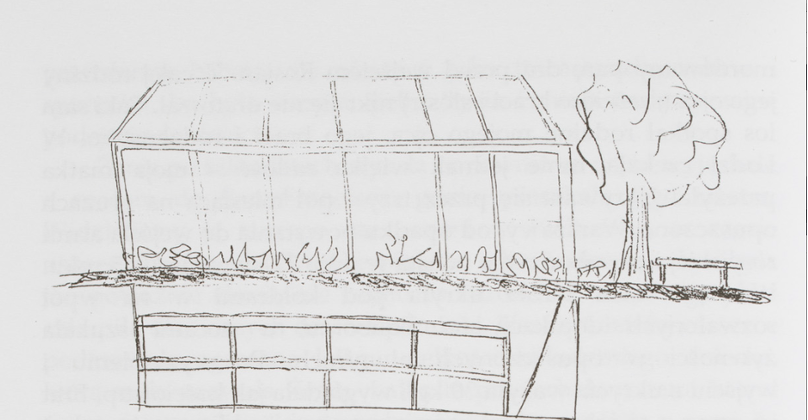
Jagur left the Krysia bunker months before the Gestapo found and killed members of the Wolski family and the thirty-eight Jews hiding there.
Just as these Jews were discovered and killed, a considerable number of Jews living in other hiding places did not survive the Holocaust. Their stories of life in hiding still remain alive today, through diaries, memories, notes, and documentation. Their testimonies also provide evidence of their experiences and of the Nazi persecution which drove them to endure such insufferable conditions.
More on Hiding:
- Donat, Alexander. “A Survivor’s Report from One Shelter.” In The Holocaust Kingdom: A Memoir, 395–399. New York: Holt, Rinehart, 1965.
- Dowell, Stuart. “Gone but not forgotten: Warsaw’s largest hiding place for WWII Jews remembered.” The First News. March 24, 2020.
- Jagur, Orna. „Krysia” bunker. Łódź: Oficyna Bibliofilów: 1997.
- Jagur, Orna. The Hiding Place. Łódź: Oficyna Bibliofilów, 2000.
- Life in Shadows: Hidden Children and the Holocaust, USHMM Exhibit
- Moynahan, Colin. “The Nazi Downstairs: A Jewish Woman’s Tale of Hiding in Her Home.” The New York Times. October 5, 2018.
- Paldiel, M., & Littell, F. H. Sheltering the Jews: Stories of Holocaust rescuers. Minneapolis (MN): Fortress Press, 1996.
- Paulsson, Gunnar S. Secret City : the Hidden Jews of Warsaw, 1940-1945. New Haven: Yale University Press, 2002.
- Pinkus, Oscar. “Descent into Hell: Life Under Manure.” In The House of Ashes, 342– 348. London: I.B. Tauris, 1991.
- Werman, Marco. “This Jewish couple survived the Holocaust hidden behind a church organ.” PRI. November 27, 2015.
Passing
In the context of the Holocaust, passing was the act of Jews concealing their identities as a non-Jew to escape Nazi anti-Semitic policies and discrimination. This usually involved acquiring false papers, which were incredibly difficult if they were residing in Nazi-occupied lands, adopting another faith, and sometimes changing their physical features to appear to fit the Nazi stereotypes for “Aryan” appearance. Aryans, as ambiguously denoted by the Nazis, were considered a racially superior group of people that descended from Northern Europe and were gentiles.

False Papers
Those who passed also often had to acquire false papers, and false papers were also sometimes used to try and cross borders and escape Europe.
Obtaining false papers was no easy feat. Oftentimes, families would do so by contacting anti-Nazi resistance organizations and receive them under new names, leaving their old identities behind. Some papers were authentic and would sustain them during routine inspections and examinations of identifications. These investigations would often lead to Jews being apprehended as a result of trying to pass. Unfortunately, once they were caught, they had only one of two fates: immediate death or deportation to concentration camps. Despite the amount of danger that came with falsifying their papers, survival seemed to eclipse that fear. However, even among the trials and tribulations that the Jews faced, there was an important figurehead who had both received, provided false papers, and saved thousands of European Jews: George Mandel-Mantello.
George Mantello (born George Mandel) was a Hungarian-Jewish businessman living in Budapest as the Nazi Party rose to power. With Hungary recently aligning itself with Germany in 1939, restrictions were placed on Jews, which began to threaten his life and the lives of his family. As a businessman, Mantello established a friendship with the Consul General from El Salvador, Coronel Jose Arturo Castellanos. Castellanos invited him to work in Switzerland (a neutral country during the Second World War), where Mantello would be relatively safe from Nazi persecution. During this time, Mantello created a fake title as the First Secretary of the Consulate General of El Salvador at its representation in Switzerland and adopted a new surname, Mantello, to sound more Spanish or Italian.

The operation that spanned thousands of papers began with a group of Jews requesting Mantello for money to buy certificates of Latin American countries that allowed Jews to escape Nazi-occupied Europe. Surprisingly, Mantello was rather insulted by their ask, more so by the fact that there were people who were purposefully exploiting Jews’ safety for profit. With the approval of Castellanos, he began work to issue official documents that would provide protection over whoever possessed it. The documents officially identified the Jew as a Salvadoran citizen and deterred Nazi officers from harming someone with protected status. Unfortunately, there were some instances of the certificates not arriving on time for the intended person. However, in these cases, the papers were not wasted as there was usually no photograph on them, and if there were, they were easily removed, thus allowing for other people to use them.
George Mantello 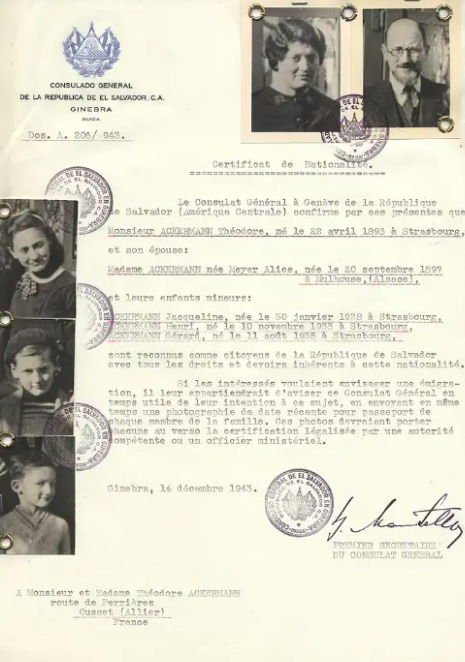
Fake certificate for a family of five issued by Mantello

Under the Guise of Religion
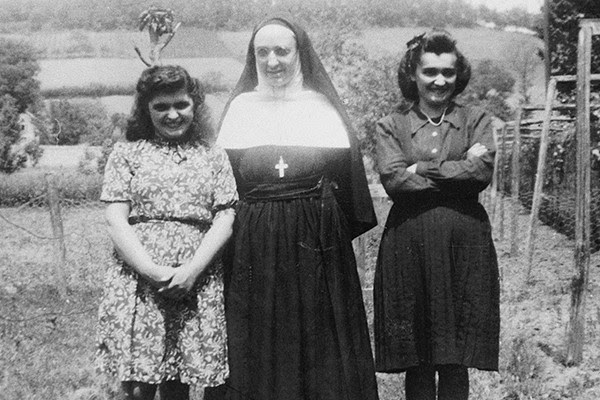
Many Christian establishments and families under Nazi-occupied lands took in Jewish children; for instance, in the town of Le Chambon-sur-Lignon, France, Protestant townspeople took in several thousand Jews. In Albania and Yugoslavia, Muslim families also participated in the hiding of Jewish children.
The town of Le Chambon-sur-Lignon, France 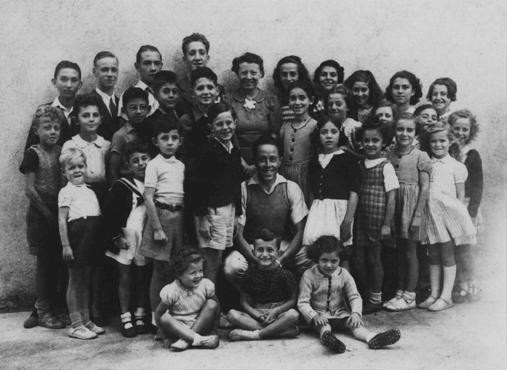
The children who sought refuge in the town taken in August 1942

As a means of survival, Jewish children and adults had to learn prayers of their “new” religions; being able to recite another religion’s prayers demonstrated to Nazi officers that they were not Jewish and allowed for them to “pass.” In fact, children were often baptized as Christians to further solidify their security. Usually, these children did not have any other option, and as a result, their identities as Jews were smeared away. Moreover, these “Hidden Children” have been the subject of contemporary controversy. It stems from asking the Vatican to release baptismal records of children so that they may rediscover their Jewish roots.
An important figure of Holocaust history who had renounced his Jewish faith was Victor Klemperer. He was a Romance language academic living in Nazi Germany who had converted to Christianity before the rise of Nazism, married an Aryan before the Nuremberg Laws, served in the First World War, and was integrated within German society where he established connections and contacts all of these factors which allowed him to avoid deportation.
Although his experience of baptism is different, as it was a result of better adjusting himself to his academic goals, it still played as one of the determinants of his ability to stay and not be deported to a concentration camp. Oftentimes, these social aspects were key players when Jews passed as Gentiles. Those who were involved in little to no religious Jewish activities, could feign Catholic rituals, and much like Klemperer, were integrated within the social milieu, were much more likely to survive and pass through this incredibly harrowing time.

Altering Appearances
Although some Jews could physically pass as Aryans, this was an easier feat for Jewish women as men were circumcised as infants. This practice was religiously significant for Jews as it signified the covenant between God and Abraham; in fact, it is so crucial to the Jewish faith that there were still several individuals that observed this practice during the Nazi regime. Since Gentiles were typically not circumcised, Nazi police were able to check males and determine their identity. Boys typically avoided using public restrooms and participating in sports like swimming to conceal themselves. In rare instances, they had to have painful procedures to hide the mark or even had to dress as the opposite sex.
The Invisibles, a movie based on a true story, documents four young Jews living in the Third Reich. Hanni Weissenberg, now Hanni Lévy, survived the Nazis by abandoning her identity, dying her hair blonde, removing her Jewish star, which was illegal, and changing her name to Hannelore Winkler. Her fellow Berlin survivors that were part of the movie also had to find clever ways to escape Nazi suspicion. “Cioma Schönhaus, was an art student who became an expert forger of documents. Another, Ruth Arndt, was a young woman who worked in a German officer’s house. He knew she was Jewish but kept the secret. Eugen Herman-Friede escaped suspicion by wearing the Hitler Youth uniform of the son of the family who hid him” (Beardsley, 5-6).
Hanni Lévy in the past and now 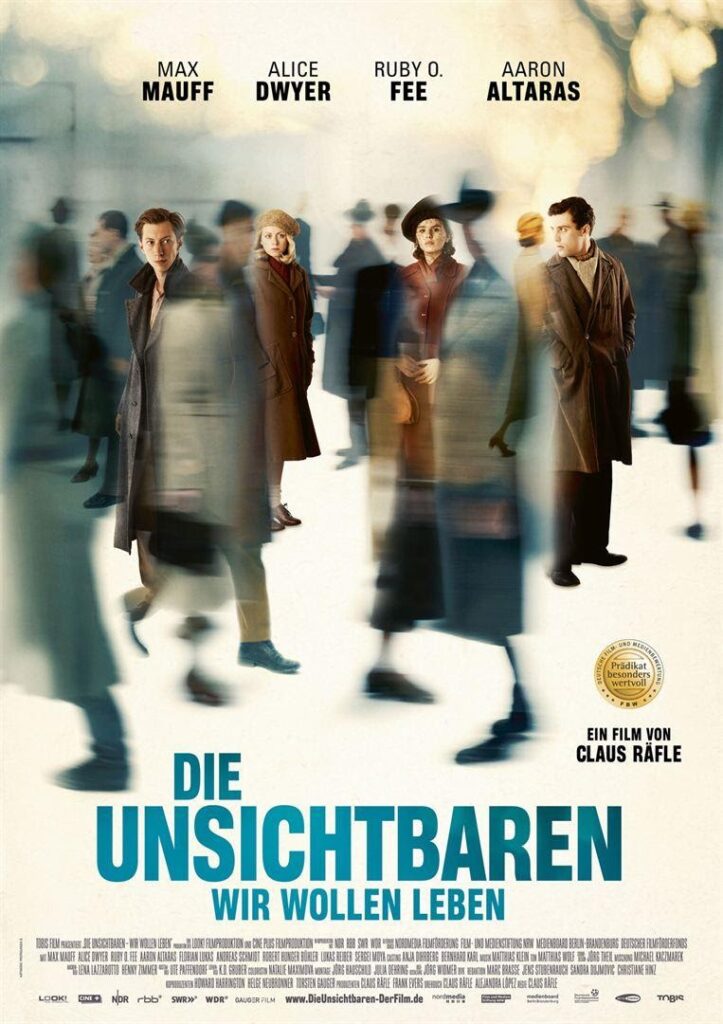
The movie poster for The Invisibles in German

As many Jews “passed,” fear and anxieties took hold of them; however, in order for them to survive the scrutinizing glances of the Nazis, they had to use every last bit of strength to conceal their feelings and thoughts. These intense emotions permeated the narrative told by Catherine Klein, the wife of a Jewish doctor, who was able to receive fake papers to board the train en route to Switzerland to later join her husband in England. Through her journey, she stammers and fumbles. With her forged passport filled with purposeful blemishes and damages, she could only “smile in splendid unconcern. [She was] smiling for my life” (Klein in Eisenberg, 358).
Her smile was a beacon of hope that the man did not notice anything, perhaps not just a way to shield herself from the officer’s thorough investigation, but a way to calm herself: “lifting the book quite close up to his eyes, he exclaims, “What’s this? Something exceedingly queer.” Each one of his words strikes [the woman] like a whip. Nevertheless, [she] keep[s] smiling. There is no change in [her] expression, none at all.” Her maniacal smiling demonstrates the mental fortitude it took to deceive the Nazis and highlighting the high amount of risk that was involved in each operation (Klein in Eisenberg, 358).
Jews that had Aryan features and could “pass” had to make the ultimate sacrifice of giving up their identities for their survival. Hiding in plain sight of the Nazis was an incredibly harrowing journey, as Lévy best explains it as: “you just had to ignore the fear in your gut and push it away, become someone else” and “lose [yourself] in the masses” (Beardsley, 3).
More stories of Passing:
- Emanuel Tanay’s oral history at USHMM
- Grynberg, Henryk. The Jewish War and The Victory. Evanston: Northwestern University Press, 1996.
- Klein, Catherine. “I am smiling for my life…” in Azriel Eisenberg, ed. Witness to the Holocaust, 350-60. New York: Pilgrim Press, 1981.
- Kuper, Jack. Child of the Holocaust. New York: New American Library, 1987.
- Neuman, Ariana. When Time Stopped: A Memoir of My Father’s War and What Remains. New York: Scribner, 2020.
- Roseman, Mark. A Past in Hiding : Memory and Survival in Nazi Germany. New York: Picador USA, 2002.
Armed Resistance
When deportations of ghetto prisoners began, some prisoners organized revolts in hopes of escaping or preventing their deportation to death camps. These rebellions were mostly unsuccessful, as the access to weapons was limited, and the possibility of escape was miniscule. Many Jews still chose to fight back, believing their deaths were inevitable and finding purpose in dying with honor. In a survivor’s report of a single uprising within the Warsaw Ghetto, the survivor describes the emotions felt by many Jews who participated in armed resistance: “although we were all doomed to a terrible death, we were gripped by a strange ecstasy… Suddenly I felt beyond life and death. I felt sure we were going to die; but I felt a part of the stream of Jewish history” (Donat, 397).
In more than 100 ghettos throughout German-occupied zones, Jews formed resistance groups, and some escaped to join partisan units in forests outside the ghettos. These fighting units resisted Nazi oppression by killing thousands of German soldiers, derailing trains, and forging ID papers for Jews to pass as non-Jews. On January 21st, 1942, members of youth movements formed the United Partisan Organization after learning of the killings at Ponary in the woods outside the Vilna ghetto. The United Partisan Organization helped pass information between ghettos so that weapons could be smuggled for the Jews. Due to legal restrictions which prohibited Jews from possessing weapons, this was particularly difficult to achieve, and successfully smuggling weapons into the ghetto was a rare occurrence. In September of 1943, the Jews learned of German plans to liquidate the Vilna ghetto, so members of the resistance fought the Germans until the ghetto was destroyed. Some managed to escape the ghetto through the sewers and join partisan units in the forests. These units initiated partisan warfare, which became one of the major methods of participating in armed resistance during the Holocaust.
The largest Jewish uprising occurred in the Warsaw Ghetto in German-occupied Europe. In October of 1942, Heinrich Himmler, one of the leading Nazis of Germany, ordered that the Warsaw Ghetto be liquidated and its inhabitants be deported to concentration camps. Initially, this threat was thwarted, as a group of Jews with weapons resisted and caused the deportations to be suspended. However, the Nazis planned to resume deportations on April 19, 1943, and found the ghetto streets empty.
Hiding in bunkers, the members of the underground Jewish Combat Organization (ZOB) armed themselves with handmade grenades and guns. On the first day of the Warsaw Ghetto Uprising, the resistance fighters forced the Nazis outside of the ghetto wall. On the third day, the Nazis began destroying the ghetto, bringing the Jews out of hiding. However, others fought the Nazis and stayed hidden in the ghetto for almost a month. Tens of thousands of Jews were killed or deported to camps or killing centers during this revolt, but the Warsaw Ghetto Uprising was an inspiration for further armed resistance.

From the Warsaw Ghetto revolt sprouted a flurry of resistance movements across the European continent. Not too far from Warsaw, a death camp primarily for Jews and Roma, the Treblinka Rebellion of 1943 took root. According to Samuel Rajzman, one of the camp’s few survivors, “[their] task was to avenge at least to some extent the millions of innocent people executed… dreaming of setting fire to the whole camp and exterminating at least the cruelest engines at the price of their own lives.”
On August 2, 1943, the dream had come to fruition; with the stolen munition from a construction site, the prisoners waited for a single gunshot signal. However, during a struggle against a Nazi guard, two conspirators had to shoot the guard, thus prematurely launching the sign. In a chaotic series of events involving the burning of Treblinka, about 300 people were able to escape the camp, and 40 Nazi guards were killed in the process.
Only 70 of the 300 prisoners were able to survive the war, as many were caught immediately by the Nazis in cars and on horses. Those who did not try to escape were punished alongside those who did. The Treblinka revolt of 1943 culminated in the Nazis murdering all of the remaining prisoners. These rebellions began to spring up in other camps such as Auschwitz and Sobibor, another death camp similar to Treblinka.
Captured by a railroad worker, the burning of Treblinka can be seen from a distance away, demonstrating the sheer scale of destruction by the prisoners. 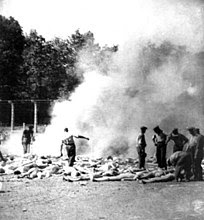
A Sonderkommando group forced to disposed of Holocaust victims’ bodies taken in August 1944.

Northeast of the women’s barracks within the now-infamous Auschwitz-Birkenau concentration camp, a ripple of resistance meandered around a group of four courageous women. Months before October of 1944, Ester Wajcblum, Ella Gärtner, and Regina Safirsztain had been smuggling gunpowder from the Weichsel-Union-Metallwerke, a firearm factory located within Auschwitz, and giving it to the camp’s resistance movement. Róza Robota was a young woman working in the clothing department; she worked with the three women to pass on the gunpowder to the Sonderkommando.
The Sonderkommando was German for “special unit;” those who had been sentenced to work as Sonderkommandos were already on the brink of death. These units were comprised of prisoners (mostly Jewish), who were in charge of extracting the victims from the gas chambers, removing their hair and valuables, and burning the bodies to rid any evidence of genocide. Life as a Sonderkommando was incredibly gruesome, and after their term was finished, they would be executed by the Nazis, and a new group of victims would come and take their place.

On October 7th, 1944, the Sonderkommando of Crematorium IV learned of the Nazis’ plans to liquidate the unit; choosing to die fighting, the group of condemned prisoners launched a revolt. However, the Germans were able to suppress the insurrection; in total, almost 500 prisoners lost their lives trying to fight for their freedom. After the uprising, the group of women who had helped bring ammunition and explosive materials into the camp was identified and executed mercilessly.
Beyond the well-documented voices of various Holocaust survivors, those who had their lives stripped away from them before they could tell the world their story are often left in a cloud of anonymity and ambiguity. Especially in armed resistances, there were often very few survivors to relay the exact details, and thus the victims’ stories appear to disintegrate with the passage of time. However, through the vast historical analysis of the Holocaust, their voices can be gradually uncovered. In the case of these unsung female heroes, they are part of a scheme that demonstrated the resiliency of Jews during such a fraught time.
More reading on armed resistance:
- Bugos, Claire. “The Untold Story of Jewish Resistance During the Holocaust.” Smithsonian Mag. August 6, 2020.
- Edelman, Marek. “The Ghetto Fights.” The Warsaw Ghetto: The 45th Anniversary of the Uprising, 17-39. Interpress Publisher.
- Henry, Patrick. Jewish Resistance Against the Nazis. Washington: Catholic University of America Press, 2014.
- Krakowski, S. The war of the doomed: Jewish armed resistance in Poland, 1942-1944. New York: Holmes and Meier, 1984.
