By Laura Collins ’21 and Virginia French ’24
This section contextualizes Nazism across space and time. We analyze the ways that British colonialism, American eugenic policy and racism, and the early roots of anti-Semitism served as inspiration for and had an impact on Nazi ideology and policy. European imperialist governance was built on violent forms of racial hierarchization, power, and control.
The Nazis cited American eugenics and race policy as a model for their regime. Serving as more than just an inspiration, American consumers and businesses collaborated with Hitler and the Nazi Party. Hollywood and the motion picture industry was one such “business partner”—they provided not only monetary support to the Nazi regime, but also acquiesced to their propagandistic agenda. Other Nazi sympathizers, like Charles Lindbergh and the ‘America First’ Committee, spread Nazi propaganda and antisemitic rhetoric on a national level.
Further, Anti-Semitism did not begin with the Nazis—anti-Jewish ideology and scapegoating has been a pattern throughout history. Though the Holocaust stands out for its extremity and scale, it did not occur in a vacuum—global ideologies regarding racism, anti-Semitism, and colonialism had major influences on Hitler and the Third Reich.
Imperialism in Context
For decades preceding the rise of Nazism, much of the world operated under racist control and imperial conquest for resource acquisition and the struggle for power. For this reason, British imperialism and German colonialism throws Nazism into a new light.
British Colonial Influence
Meanwhile the dream of a Colonial Empire had taken deep hold on the German imagination.
Crowe, p. 4
An important factor in giving global context to Nazism is British Colonialism. Though scholars note the ways that contemporary Britain tries to separate its history from Germany’s, there is considerable evidence that British colonialism served as inspiration for Germany in their formation of imperialist policy, in addition to influencing the construction of Nazi racial hierarchies.
In a piece from Dr. Friedrich Fabri, the “British connection” is evident: “‘That nation is the world’s greatest, which colonises most; if it is not the greatest today, it will be tomorrow.’ No-one can deny that in this direction Britain far surpasses all other States (Fabri, 7).” Further, Fabri notes explicitly the ways that British racism was an inspiration for the Germans: “the correct method of administration may be said to have been already established through the fortunate fact of Britain’s having applied it first. Since the centre of gravity of these sub-tropical colonies rests entirely upon the white immigrants, they necessarily oust the generally scanty residue of coloured natives (Fabri, 5).” Though Germany wanted to develop a “unique” version of German colonialism, it nonetheless looked to the British Empire as a model for their own colonialism.
This connection was recognized on the British side as well. In a piece from the turn of the 20th century concerning German Policy from the British perspective, the British reveled in the way that their self-proclaimed “exceptionalism” influenced Germany: “The colonies and foreign possessions of England more especially were seen to give to that country a recognized and enviable status in a world where the name of Germany, if mentioned at all, excited no particular interest. The effect of this discovery upon the German mind was curious and instructive (Crowe, 4).”
The British Empire, which by the end of the 19th century included a quarter of both the globe’s land space and population, was viewed by the Germans as the definition of “global power”—something that they sought for themselves. British colonialism—with its obsession with power and racial hierarchy construction—clearly served as inspiration for the construction of Nazi policies surrounding colonialism and racialization.
Further reading:
- Darwin, John. The Empire Project: The Rise and Fall of the British World System, 1830-1970. Cambridge: Cambridge University Press, 2009.
- Mohanram, Radhika. Imperial White: Race, Diaspora, and the British Empire. Minneapolis: University of Minnesota Press, 2007.
- Langbehn, Volker and Mohammad Salama, ed. German Colonialism: Race, the Holocaust, and Postwar Germany. New York: Columbia University Press, 2011.
- To view a map comparing British and German colonies in South Africa, click here.
German Colonialist Violence
Beginning in 1884 with the Scramble for Africa, Germany built a smaller colonial empire, claiming much of the left-over land, as they were late to expand beyond European borders in comparison to France and Britain. They established colonies in German Togoland (now part of Ghana and Togo), Cameroon, German East Africa (now Rwanda, Burundi, and Tanzania), and German South-West Africa (now Namibia). Their imperial rule consisted of a governmental system parallel to that of Germany, leading from the top down.
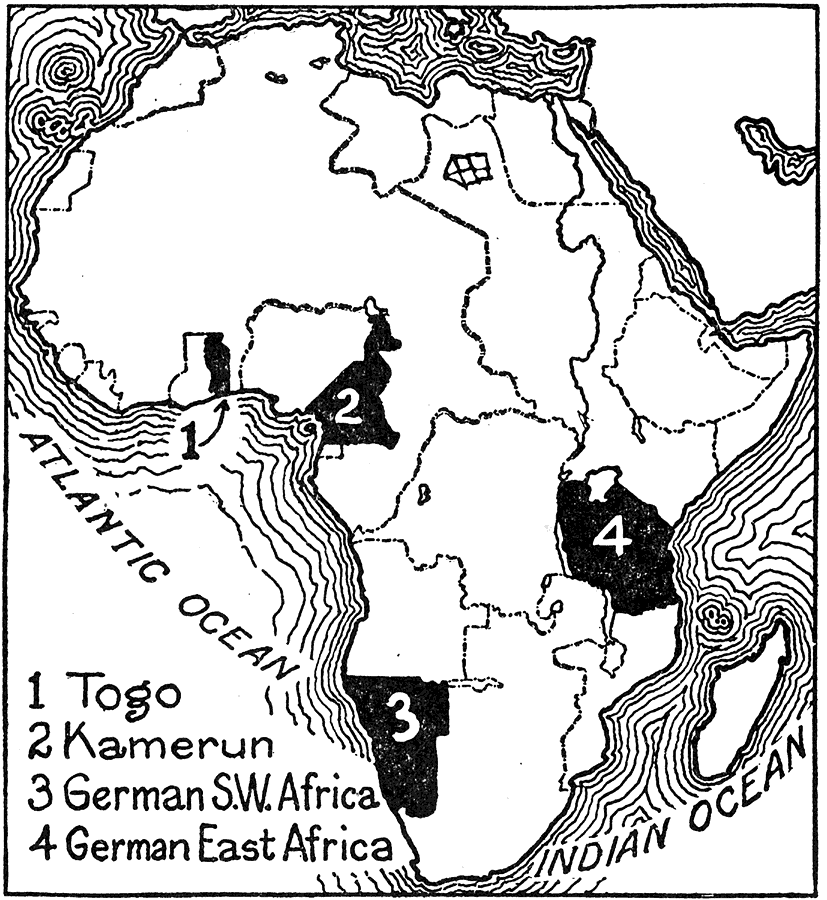
At the heart of German imperial policy lies a warning about the violent tendencies between the collaboration of the German government and the German military, especially when such systems utilize mass death as a way to gain militarial power. Colonial German practices prove that the mentality of Nazism predates the actual formation of the National Socialist German Workers’ (Nazi) Party. The Imperial German Army increasingly pursued the destruction of its enemies (largely native civilians) as the only way to achieve national security in its colonies. Historian Isabel Hull has traced the way that German Imperial policy belies a German military willingness to ruthlessly and completely annihilate the enemy for the sake of the German state even before World War I. Her term “absolute destruction” implies more than just ordinary military practices and, thus, will end in serious human consequences when concerning a modern power.
In the words of Hannah Arendt, “violence, being instrumental in nature, is rational to the extent that it is effective in reaching the end that must justify it,” but “extremism occurs when the means overwhelms the end” (quoted in Hull, 1). The German military extremism, presented as early as 1870 in the Franco-Prussian War, which inaugurated the German imperial era, gravitates towards “final” or “total” solutions, foreshadowing the “Final Solution to the Jewish Question.” In general, we attribute the extremism of genocidal mass murder to the ideology proclaimed by the perpetrator. Nonetheless, military practices and institutional routines translate this extremist ideology into action under the context of war. Nations, such as Germany, that perceive many “final solutions” to various problems, not just in genocidal practice, pave the way for genocide to occur down the road.

While other Western nations, specifically Britain’s actions in the Boer War (1899-1902), also tended to veer towards violent policies in military application, clear violence was later stopped by the intervention of a party outside the military, either civilian government and/or public opinion; however, this did not occur in Germany. For example, Kaiser Welhelm II praised German forces for conquering the indigenous population in the Herero Revolt in Southwest Africa in January of 1904. In this rebellion, the German army killed 75% of the Herero population. On November 25, 1905, the Kaiser exclaimed that “I know that I speak for the German people when I warmly thank and proudly acknowledge the officers and troops who answered my call and defended our territories with heroic courage at risk to their own lives” (Welhem II, “Reichstag Speech”).
Later, from 1915 to 1918, Germany accepted the genocide perpetrated by its ally Armenia, even after this became militarily counterproductive. Ulrich Trumpener, a military historian publishing foundational work concerning the Armenian Genocide, argues that Germany “neither instigated nor welcomed the genocide,” but he finds the ally guilty of extremely poor moral judgement in their lack of obligation to intervene as hundreds of thousands of innocent people were massacred (Hull 3). However, Vahakan N. Dadrian, an Armenian-American sociologist and historian, considers Germany to be complicit as Germans contributed to the ideology that deportation is necessary in the attempt to consolidate ethnically (Hull 3). He also demonstrates that German officers ordered or participated in the deportations, and they continued to support the genocide by giving meals to many of the main perpetrators of the ethnic massacre (Hull 3).
In conclusion, Germany’s involvement in the Armenian Genocide remains controversial, but nevertheless, their reluctance to intervene reveals a violent predisposition in colonial practices that predates Nazism. Even Germany recognized that colonies did not serve them economically, further providing evidence for other motivations for violent practices in colonial rule, such as power and racism. The propensity towards violence based in racism, nationalism, and power contextualizes Nazism as having roots in the practices of the ruthless German Imperial Army.
Further reading on German Colonies:
- Bloxham, Donald. Genocide, the World Wars and the Unweaving of Europe. London: Vallentine Mitchell, 2008.
- Hull, Isabel V. Absolute Destruction: Military Culture and the Practices of War in Imperial Germany. Cornell University Press, 2005. Accessed 1 Nov. 2020.
- Die Reden Kaiser Wilhelms II [The Speeches of Kaiser Wilhelm II], edited by Johannes Penzler. 4 vols. Leipzig, n.d., volume 3, p. 289.
- Rosa Luxemburg, “Brauchen Wir Kolonien?” [“Does Germany Need Colonies?”], Leipziger Volkszeitung, December 4, 1899.
Racism and Ideology
American racism served as inspiration—both ideologically and legislatively—for Hitler and the Nazi Party. Hitler was inspired by American ideas regarding Manifest Destiny, Eugenics, and Jim Crow policy. The American Eugenics movement was rooted in the idea of a “superior” and “inferior” race and employed mechanisms to control reproduction, including marriage laws, sterilization, segregation, and immigration quotas.
American Eugenics Policy
The American eugenics movement, which was at its strongest between 1890s and 1940s, is another relevant factor to consider in contextualizing Nazi ideology and policy. The rhetoric and stated “objectives” of such a movement mirrored speeches and documents written by Hitler and other members of the Nazi party: in an article concerning the Committee on Eugenics in the United State, it states, “Distinguished Scientists Selected by Assistant Secretary of Agriculture Hays Will Endeavor to Emphasize to Society the Menace of Inferior Blood and the Value of Superior Blood” (Washington Post, 13). Similar ideas and rhetoric permeate Hitler’s Mein Kampf: “if an individual member of a race should mingle his blood with the member of a superior race the first result would be a lowering of the racial level” (Hitler 396).
The influence that American eugenics policies had on Nazi Germany is explicit. Nazis referenced American eugenics as inspiration for their own eugenic policies. At the turn of the 20th century—several decades before the Holocaust—the United States enacted eugenics ideology as official policy in a number of ways: segregation, immigration quotas, limited marriage/reproduction of individuals across perceived racial lines, and sterilization. As a result of the passage of Indiana’s 1907 eugenic sterilization law (and the Supreme Court’s decision to uphold the constitutionality of that law), 70,000 Americans were sterilized during the 20th century.
Many of these elements are reflected in Nazi policy. In 1933, the Nazis passed the “Law for the Prevention of Offspring with Hereditary Diseases.” The law explicitly permitted that “Anyone suffering from a hereditary disease can be sterilized by a surgical operation.” In 1935, Nazi Germany put into place the “Nuremberg laws,” which forbade marriage and sexual relations between German Jews and Aryans. Important to note, however, is that while the Nazis used American racism as a template for their own system of racial hierarchy, they did not adopt the American “one drop rule,” which categorized a person as legally Black if they had any history of Black ancestry at all. With the Nuremberg Laws, the Nazis categorized someone as Jewish if they had three or more grandparents. As noted by James Whitman, author of Hitler’s American Model, “the one-drop rule was too harsh for the Nazis (or at least for most of them)” (Whitman 128). Additionally, with respect to sexual oppression, the Nazis falsely promised freedom from the concentration camps to gay men whom underwent castration. The connection between the American eugenics movement and Nazi eugenics policy is clear and indisputable.
Further reading:
- Black, Edwin. War Against the Weak: Eugenics and America’s Campaign to Create a Master Race. New York: Four Walls Eight Windows, 2003.
- Kuhl, Stefan. The Nazi Connection: Eugenics, American Racism, and German National Socialism. Oxford: Oxford University Press, 2002.
- Ordover, Nancy. American Eugenics: Race, Queer Anatomy, and the Science of Nationalism. Minneapolis: University of Minnesota Press, 2003.
- Wilkerson, Isabel. Caste: The Origin of Our Discontents. New York: Random House, 2020.
- To view propaganda slides regarding Nazi eugenics, click here & here.
Further reading on “Manifest Destiny” & American Genocide:
- Madley, Benjamin. An American Genocide: The United States and the California Indian Catastrophe, 1846-1873. New Haven: Yale University Press, 2016.
- Guettel, Jens-Uwe. German Expansionism, Imperial Liberalism, and the United States, 1776-1945. New York: Cambridge University Press, 2012.
Legal Discrimination
Scholars have shown that America was, for the Nazis, a ‘classic example’ of a racial establishment. In the meeting that eventually led to the creation of the Nuremberg Laws, the centerpiece of anti-Jewish legislation in Nazi Germany, members of the Nazi regime dedicated ample time to discuss race policy in America. They saw race policies in America as a foundation for the creation of their own Nazi racial policies. In Mein Kampf, Hitler praises America as nothing less than “the one state” that had achieved the most progress in implementing a just and healthy racial system to act as a guideline for the Nuremberg Laws the Nazis sought to establish (Whitman 12). America “was the leading racist jurisdiction” in the 1930s (Whitman 138). The most virulent anti-semites in the Nazi party were the most passionate supporters of race policy in America.
In Hitler’s first major statement on anti-Semitism in 1919, he argues for a legal response to the Jewish question, based in reason rather than emotion. Hitler contends that “Antisemitism as a political movement must not be, cannot be, determined by emotional criteria, but only through the recognition of facts” (Hitler 1). He later returns to this idea, stating that “Antisemitism stemming from purely emotive reasons will always find its expression in the form of pogroms. But antisemitism based on reason must lead to the systematic legal combating and removal of the rights of the Jew” (Hitler 2). In this statement, he not only renounces the hatred of Jews based on morality but proclaims the obligation of the nation to legally remove Jews on the basis of political power. This viewpoint presents the clarity of Hitler’s intentionality behind genocidal policies towards Jews as he advocates for extending antisemitism in a systematic and legal way, inspired by legal American racism already in place at the time.
Hitler commended the American Immigration Act of 1924 in Mein Kampf as well, applauding the restricted entry into the United States based on inherited “national origins” (Whitman 12). The United States also created de jure and de facto second-class citizenship to discriminate against Black people, Fillipinos, the Chinese, and other various groups. The Nazis observed these American practices as they deciphered how they would enforce inferior citizenship for the Jews under their control. Anti-Jewish violence also resembled the lynchings of Black people that would occur in the American South. In the South, the American police has always been a system of racial violence, stemming from the original “Slave Patrol” in the 1700s. After the Civil War, the Slave Patrol became the modern, Southern police department, yet still, in the early-mid 1900s, their main purpose was to control freed slaves through the enforcement of Jim Crow segregation laws. State-sanctioned violence in Nazi Germany mirrors this racial profiling and police brutality in 1930s America as their state authorities can legally target, harass, and assault Jews.
Under German Nazi rule, Jews were discriminated against, beaten, and murdered, especially during the violence of Kristallnacht. At the same time, Black people in the American South were discriminated against, beaten, and murdered under Jim Crow rule. “Racism was as endemic in the South as it was in Nazi Germany in the 1930s,” but the American South refused to embrace Nazi Germany based on supposed American exceptionalism and moral high ground (Grill and Jenkins 669). Contrarily, the KKK, a broadly accepted anti-Black, murderous society, would not accept Black people or Jews into their ranks. This exemplifies the hypocrisy of America rejecting Nazi policy yet implicitly endorsing the Jim Crow South by allowing race-based legal discrimination to continue.
For instance, The Washington Post condemned the racist treatment of Black athletes in the 1936 Olympics in Berlin, even when American segregationist policy existed on the other side of the Potomac River in Virginia. This is why Jesse Owens’ significant athletic achievements in the 1936 Olympics were such a big deal. Black newspapers in the 1930s drew these parallels as early as 1933 and throughout the rest of the twentieth century. Overall, Nazis found precedents, parallels, and inspirations from the American nation in the creation of their racist, nationalistic regime.

Further reading:
- For more on Nazi racism, click here.
- Grill, Johnpeter Horst, and Robert L. Jenkins. “The Nazis and the American South in the 1930s: A Mirror Image?” The Journal of Southern History, vol. 58, no. 4, 1992, pp. 667–694.
- Potter, Gary. The History of Policing in the United States. Eastern Kentucky University Online.
- Whitman. James Q. Hitler’s American Model: The United States and the Making of Nazi Race Law. Princeton University Press, Princeton; Oxford, 2017.
Collaborating with the Nazis
Taking a closer look at Hitler’s relationship with Hollywood provides access to America’s perception of Hitler and Nazi Germany. With respect to cinematic history, considerable attention has been given to one performance in particular, We Will Never Die, which was written by a Hollywood screenwriter Ben Hecht. The performance was sponsored by Zionist Revisionist Bergson Group, which used the performance as ammunition to influence U.S. government intervention into the Holocaust. Other films, such as The Mortal Storm and So Ends Our Night, were examples of anti-Nazi Germany stances in cinema, all of which were banned in Nazi Germany. Disproportionate attention to pieces like these obscures the ways that Hollywood producers acquiesced to and collaborated with Nazi propaganda demands.
Several scholars have discussed this relationship between Hollywood cinema and Hitler. One important debate is between Ben Urwand and Thomas Doherty. Essentially, this debate concerns whether or not Hollywood and its executives should be considered “collaborators” with the Nazis. In his book, The Collaboration: Hollywood’s Pact with Hitler, Ben Urwand highlights not only the role that Hollywood played monetarily with the Nazis, but also how—as an entity that disseminates information—Hollywood’s acquiescence to Nazi censorship and propaganda agendas ultimately impacted American perceptions of Nazi Germany.
Thomas Doherty, on the other hand, takes a different stance on Hollywood’s relationship with Hitler and Nazi Germany. In his book, Hollywood and Hitler, 1933-1939, Doherty argues that while there were business deals between Germany and Hollywood, “the motion picture industry was no worse than the rest of American culture in its failure of nerve and imagination, and often a good deal better in the exercise of both (Doherty, 12).” Other examples of American collaboration with Hitler’s Third Reich include anti-semitic figures such as Avery Brundage and Charles Lindbergh. These individuals were involved with the ‘America First’ Committee, a staunch isolationist organization accused of spreading Nazi propaganda.

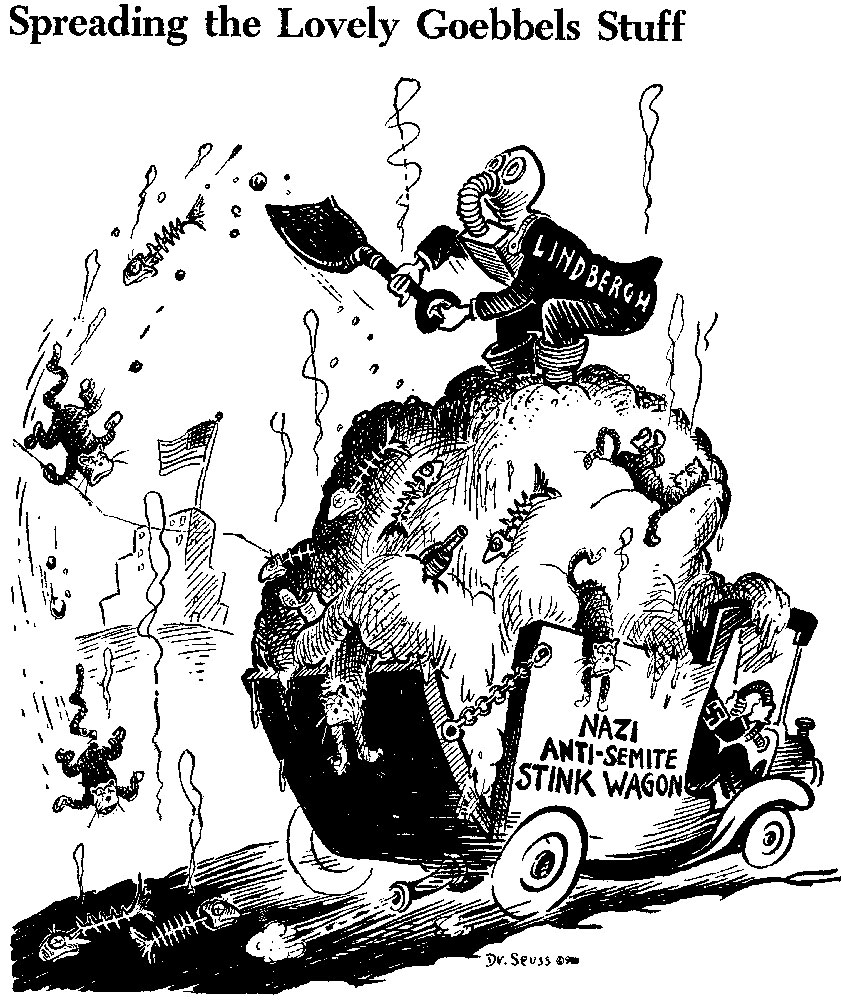
Though a much more complicated debate, some argue that the failure to bomb Auschwitz was rooted in a similar ideology to ‘America First’ isolationism. Avery Brundage, also involved with the U.S. Olympic Committee, prevented two Jewish runners (Marty Glickman and Sam Stoller) from participating in the 1936 Olympics held in Berlin. Charles Lindbergh refused to denounce Nazi Germany when asked to do so publicly. ‘America First’ and its anti-semitic rhetoric was on the national stage—reaching at one point a membership of 800,000. Like Hollywood, ‘America First’ and its following gives us a closer look at how a large portion of the American public collaborated with Hitler and Nazi Germany during the Holocaust.
Further reading:
- To hear an excerpt of an oral history from Marty Glickman, one of the Jewish runners prevented from competing in the 1936 Olympics, click here.
- Antisemitic speech given by Charles Lindbergh in Des Moines, Iowa (1941).
- Urwand, Ben. The Collaboration: Hollywood’s Pact with Hitler. Cambridge: Harvard University Press, 2013.
- Doherty, Thomas. Hollywood and Hitler, 1933-1939. New York: Columbia University Press, 2013.
Anti-Semitism before the Nazis
Historically, what started as religious and cultural prejudice evolved into a systematic practice of political, economic, and social isolation, as well as legal discrimination, degradation, and attempted annihilation—commonly known as anti-Semitism. The Nazis did not present anti-Semitism as a new ideology, but rather, they drew on a wide and detailed array of anti-Semitic beliefs. The hatred of Jews existed long before Nazism, and it did not end after the Nazis’ defeat in World War II either.
Institutionalized discrimination against Jews occurred throughout the Middle Ages through restricting marriage with Christians, forbidding Jews to hold governmental positions, and prohibiting them from testifying against a Christian in court. The narrative construction of Jews as the ‘enemy’ occurred in tales of fantasy, in addition to serving as the scapegoat for the Bubonic Plague. In the blood libel myth, people believed false accusations that Jews with horns and tails sought to routinely murder Christians as they wished to use Christian blood in their own religious rituals. Martin Luther wrote a book entitled The Jews and Their Lives, desperately petitioning for people to kill the Jews on the basis of blood libel. Jews were forbidden from owning land, so they were forced to moneylend, giving rise to the stereotypical characterization of Jews as money-hungry and greedy. Landowners also forced them into this practice, since they needed moneylenders themselves. Beginning in the thirteenth century, Jews were ghettoized and forced to wear a defining symbol, making them immediately identifiable. Though the last European ghettos would be abolished in the 19th century, the Nazis would revive these policies, with greater vehemence and force, after the invasion of Poland in 1939.

The religious to political transition from anti-Judaism, the resentment of Jews because of their refusal to accept Christianity, to anti-Semitism, the hatred of Jews as a race that would pollute the purity of another race, is marked by the European economic hardship faced in the turn of the twentieth century. Following their formal emancipation in 1848, in which German Jews fought to integrate into society as formal citizens as they had been previously isolated within their own enforced residential, ghettoized areas, German Jews had worked hard to enter into their own social, economic, and professional spheres. However, as the nineteenth century came to a close, economic displacement brought about by industrialization and a period of economic depression, precipitated escalating hostility towards Jews.
An editorial in Die Zeitung des Judenthums, the Jewish newspaper in Germany, called for an assembly of German Jews to counter the growing anti-Semitism. The writer proclaimed that “the history of the suffering of our tribe and our faith is age-old and always remains the same; the forms under which it manifests itself, however, change according to the general cultural conditions of the respective nations” (Kastan). In this statement, he acknowledges that prejudice towards Jews has always been a part of Jewish history, yet he claims that the Jews of Germany have exceeded expectations in terms of advancing intellectual life as “it is no coincidence that the rebirth of the Science of Judaism occurred in Germany” (Kastan). However, persisting anti-Semitism ignores this great academic attribution of the Jews.
There was still a “wall of separation” in Germany between Jews and non-Jews, supported by the fact that “the painful insult that the current movement presents, and must present, to us German Israelites lies in the fact that we know that we are of one spirit with the German people, while also realizing that some nevertheless seek to erect a wall of separation and push us back” (Kastan). No matter the advantages that Jews could provide, Germans still upheld the belief that they were not allowed to prosper in the German society because “they want to rob us of our share of the cultural life of the German people” (Kastan).
In 1873, Welhelm Marr, a German political demagogue, defined the term “anti-Semitism” in his work Victory of Judaism over Germanism, in which he hypothesized that the Jews wished to overthrow the state and, therefore, should be denied citizenship. This belief would later present itself again when Hitler created conspiracies about the Jews’ effect on the economic depression in the interwar period. Also, from the late 1800s to the early 1900s, racism and anti-Semitism were falsely justified by Herbert Spencer’s notion of Social Darwinism based in theories of racial superiority and inferiority.
Furthermore, initiated by its circulation in France by Tsarist secret police in 1904, The Protocols of the Elders of Zion is infamous because it is the most widely distributed and accepted, anti-Semitic publication in history. This source falsely speculates that Jews harbor a “secret plan” to conquer the world by “manipulating the economy, controlling the media, and fostering religious conflict” (“Protocols of the Elders of Zion”). Hitler specifically references The Protocols’ anti-Semitic, economic theory in Mein Kampf in his assertion that “it is Jews who govern the stock exchange forces of the American Union…Every year makes them more and more the controlling masters of the producers in a nation of one hundred and twenty millions” (Hitler 639).
As Elie Wiesel, author of Night and winner of the Nobel Peace Prize, describes it, “if ever a piece of writing could produce mass hatred, it is this one. . . . This book is about lies and slander” (“Protocols of the Elders of Zion”). Even though it is disproved by the London Times in 1921, The Protocols played a clear role in Nazi propaganda as the party published 23 editions between the years 1919 and 1939. Some schools used The Protocols as a primary source to indoctrinate their students into the Nazi regime. Overall, The Protocols prove that outside populations were susceptible to anti-Semitic rhetoric, which allowed the Holocaust to unfold in the manner that it did. Mass anti-Semitism helped the Nazis gain power not only in Germany but also in the places that Germany conquered as well. Moreover, the lies that The Protocols perpetrated remain available and accessible on the internet today. The Protocols one purpose was to spread hatred and generate prejudice towards Jews to this day, implemented by neo-Nazis, white supremacists, and Holocaust deniers.
Elsewhere in Europe, anti-Semitism had also taken root. Anti-Semitism not only existed in Germany, but rather, it was an ideology widely accepted in the greater European population, exemplified in the Dreyfus Affair of 1894. Alfred Dreyfus, a Jewish Artillery Captain in the French General Staff, was charged with treason. Regardless of unpromising and unfavorable evidence, he was still sentenced to life imprisonment on Devil’s Island, the French Guiana. After many protests and re-examinations, Dreyfus was finally released, rehabilitated, and readmitted into the French army in 1906. The Dreyfus Affair proves that anti-Semitism was not exclusive to Germany, but rather, it existed outside of Nazism. In their rise to power, the Nazi’s built upon this hatred of Jews, tapping into people’s pre-existing prejudice to support Hitler’s invocation of anti-Semitism into his political goals, giving rise to an environment where people wished to rid the “pure” race of the impurity of the Jews.
Following World War I in 1919, Hitler blamed Jews for hyperinflation, war reparations, military defeat, and their continuing economic struggles. Anti-Semitic conspiracies and scapegoating are a consistent pattern throughout European history, leading to the Holocaust and the Nazis rise to power in Germany. The Nazi’s insistence on anti-Semitic practices are not unique to their extremist ideology, but rather, anti-Semitism is a pattern that culminated in the mass murder of the Jewish people in the Holocaust and still persists to this day.
Further reading:
- For more on The Protocols of the Elders of Zion, click here and here.
- Anti-Defamation League. “A BRIEF HISTORY OF ANTI-SEMITISM.” Adl.org, 2013.
- Dr. J. Kastan, “Eine Generalversammlung deutscher Israeliten” [“A General Assembly of German Israelites”], Allgemeine Zeitung des Judenthums (March 31, 1893), pp. 148-49.
- Lindemann, Albert S., Richard S. Levy, and Doris L. Bergen. Antisemitism : a History. Oxford: Oxford University Press, 2010.
- Scholem, Gershom. A Life in Letters, 1914-1982. Edited and translated by Anthony David Skinner. Cambridge: Harvard University Press, 2002, p. 129.
