By Julia Mahoney ’23 and Leo Artus ’21
Ghettos played a dominant role in the subjugation and mass murder of the Jewish people during the Holocaust, often serving as an intermediary between freedom and deportation to concentration camps. The Nazi Party in Germany systematically placed Jews into small, closed off areas throughout Europe, and many died due to terrible living conditions. The Ghettos were often supervised by a Jewish Council called the Judenrat, which in and of itself was yet another twisted manipulation of the Nazis.
The following paragraphs will detail both life and death, culture, and forms of resistance within the ghettos. At the end of the page, you can find suggestions for further reading on these topics.
Everyday Life
Hunger and starvation reigned in all ghettos. Holocaust survivor Leo Schneiderman stated in an interview describing the Łódź Ghetto that, “The whole ghetto was designed, actually, to starve people out… emaciated up to nothing, people started to look like skeletons.” Another account documents the beggars on the streets of the Warsaw Ghetto, stating “Yet hunger never leaves its eyes. Mortal hunger. Its legs are getting thicker and thicker. These are not legs, but enormous blocks of flesh swollen due to starvation. They are swollen logs. It is a macabre, living example of elephantiasis pedis.” Such dehumanization of Jewish beggars in the ghetto appears frequently in accounts, since the terrible living conditions and starvation rates of the ghetto caused many to look unrecognizable from who they once were.
Disease also caused many Jews to die in the ghettos. Starvation and poor living conditions caused the rampant spread of several deadly diseases. One Holocaust poem goes:
When we had nothing to eat,
They gave us a turnip, they gave us a beet.
Here have some grub, have some fleas,
Have some typhus, die of disease.
quoted in Dawidowicz, p. 214
The lack of medical supplies, the inhumane and overcrowded living conditions, and brutality of the Nazis caused “More than 80,000 Jews died in the [Warsaw] ghetto.”
Photographer Henryk Ross took thousands of photos of his time in the Łódź Ghetto, and his work has resulted in “the most comprehensive known collection of Holocaust ghetto photographs by a single Jewish photographer” (Łódź Ghetto Photographs). His works emphasize the haunting class disparities of the Ghetto, as well as the chilling brutality that dominated ghetto life. The stark contrasts between the photos as one looks through the collection constantly addresses the varied lives of the ghetto, largely dependent on socioeconomic class and luck.
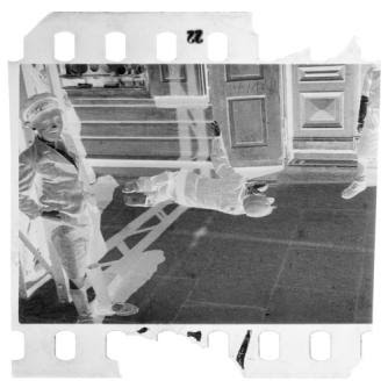
“Boy fallen on the street from hunger.”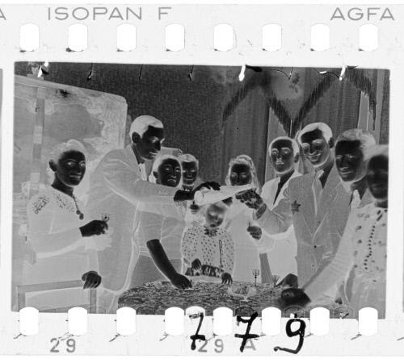
“A family gathering [with Jakob Stopnicki, daughter Krysia and wife Tania (nee Biderman)]”
Stanislaw Rózycki, a diarist who writes on the horrors he sees in the Warsaw Ghetto, describes this phenomenon of what he terms “caste conceit,” stating:
You ignore the fact that others die of starvation, suffer from oedema, or rot in prison. They are not “from your caste.” Solidarity—if it still exists, then is only within your caste.
Stanislaw Rózycki, Ulica [The Street], in The Ringelblum Archive: Underground Archive of the Warsaw Ghetto, p. 84.
The ghetto had a very survivalistic mindset, and as a result different classes stuck together for their own survival.
Many utilized criminal activities to stay alive in the ghettos. Children snuck in and out of the ghetto to smuggle in food and resources from outside. Whenever the opportunity arose, people blackmailed officials to gain leverage in the ghetto. Theft and cheating was common in marketplaces. Survival was the primary and only real goal of the ghetto, and Jewish people did everything to live through the terrible conditions of the ghetto. The Yad Vashem states, “Those individuals who were active in these illegal acts or had other savings were generally able to survive longer in the ghetto.” In order to live, Jews in the ghettos had to use whatever means possible, thus resulting in an exponential rise in crime.
In the midst of all of these horrific acts undertaken by Nazis on a daily basis, culture still had a prominent place in the ghettos. Jews fought hard, both actively and passively resisting, to keep Jewish memory alive despite Nazi’s attempt of erasure. Historian Lucy Dawidowicz states, “Like bread and potatoes, education and culture sustained life in the ghetto” (Flam, 17). Jewish identity in the ghettos played a crucial role in the survival of Jews and Jewish memory.
Lively, underground educational activities were conducted by almost all parties and ideological groups, particularly youth organizations.
Historian Emmanuel Ringelblum’s last letter from the Warsaw Ghetto
Children and youth played key roles in the cultural life of the ghettos, since parents cared deeply about raising their children well and younger generations generally contained much more passion and fervor amidst oppression. Education systems and arts programs flourished as a result. Emmanuel Ringleblum, founder of the Oyneg Shabes archives, stated in his famous last letter from the Warsaw Ghetto in March of 1944 that “Lively, underground educational activities were conducted by almost all parties and ideological groups, particularly youth organizations.”[1] Many artistic and educational endeavors sought to take focus off of the terrible hardships and allow their fellow Ghetto members to relax and reflect upon how things used to be.
One song written in the Vilna Ghetto, “Schtiller, Schtiller,” softly describes the mix of despair of Ponar and hope of the future in the form of a lullaby. This soft and sorrowful piece sings of a mother comforting her child, initially stating “There is no light” and mentioning how the child’s father has left for Ponar, a forest site of mass executions; by the final stanza, she sings of the hope of after death, since her child likely will also go to Ponar, stating “Kindle freedom’s light.” Songs such as this one provided moving and solemn comfort amongst Jews in the ghettos, providing a sense of solidarity and hope.
The composer of the piece, Shmerke Kaczerginski, a poet and member of the Paper Brigade,[2] made a great impact on the cultural life in the ghettos, and the song quickly rose to become one of the most popular Holocaust songs. In fact, “According to a note in Kaczerginski’s book, the song was performed in the Vilna ghetto by the choir, conducted by A. Slep, as well as by the partisans.”
Songs had very spiritual roots, and many relied on singing to carry them through the horrors of the ghetto. Gila Flam investigates the role of songs in the Łódź Ghetto in her book Singing for Survival, stating “The act of singing — which is fundamentally an act of creation — was paramount in the ghetto… The ghetto song symbolized survival — life, and not death… the songs, and their singing, tell the story of spiritual resistance” (Flam, 185). Music provided a religious and spiritual morale boost, dissuading many Jews from falling into despair.
Religious observances varied greatly within the ghettos, seemingly on two extremes. It appears that Jews in the ghetto either exponentially clung to their faith or they abandoned it entirely. The side each individual placed themselves on largely depended on their religious observances before the war as well as extent of the horrors they had seen. Additionally, Nazi officers treated the most pious Jews in the ghetto with the greatest violence and cruelty.
Dawidowicz writes of the twisted brutality that Nazis inflicted upon those who wore traditional Jewish clothing, detailing how soldiers “deliberately chose observant Jews” to destroy synagogue; Nazis also forced “Jews to set fire to the pile [of Torah scrolls], dance around it, singing ‘We rejoice that the shit is burning’” (Davidowicz, 201). Those who clung to their religion in the ghettos faced more targeted afflictions, but it gave them a hope and boost in spirit that others did not have.
The Judenrat
It was in the first year of the Second World War that the Judenrat was established. In September of 1939, the order came that Jewish communities should have to form councils in the occupied areas. The purpose of these councils was, according to the decree ordering their establishment, to conduct of census of the Jews in that area and to transport and housing Jews in the ghetto.
Fathers and mothers, give me your children… I must cut off limbs in order to save the body!
Chaim Rumkowski, leader of the Łódź Ghetto
The structure of the Judenrat was to be a council made up of the influential figures and rabbis from the various communities. There was to be twenty-four members in each council, and it would be led by a chairman. Only men were allowed to serve in the Judenrat.
Later in 1940 the Judenrat would take on the additional responsibility of supplying forced labor, deal with food distribution, and to assist in “evacuations.” A Judenrat was established in all the major ghettos of the eastern areas.
The Germans had several reasons for creating the Judenrat and not attempting to organize these activities themselves. First, it allowed them to make some degree of claims that the Jews in their areas had their own self-government. Second, it allowed them to avoid, at first, having Jews be placed in direct confrontation with the Nazis. Once the Judenrat had their orders, it was they who had to enforce it.
This was aided by the creation of Jewish police who, though armed only with batons, would have to maintain order in the ghettos themselves. This lessened the administrative task that the Germans had before them. It also served to create a lightning rod for Jewish anger other than the Nazis themselves. Germans noted with pleasure the friction between the Judenrats and their respective communities. Some Jews complained of the corruption of the Judenrat, endemic throughout the ghetto, and suggested that money could buy a position in the council.
There were different styles of Judenrat that choose to govern their ghettos in different ways. This was usually due to the influence of the Judenrat leader. The leader of the Warsaw ghetto Judenrat was Adam Czerniaków, a Jewish Engineer who had previously been elected to the Polish senate and the leader of a Jewish artisan organization. The Germans appointed him leader of the Judenrat in 1939 and he served until its dissolution.
He oversaw a ghetto plagued with problems that were often attributed to him. For example, the Judenrat had constant financial problems and administrative and medical workers were often not paid. The Germans mostly refused to engage with Czerniakow, and his German oversight was given to low ranking officers. This made it difficult for him to achieve any kind of reform in the ghetto. He was also known for not speaking Yiddish and generally having middleclass mannerism that led him to be accused of being an “assimilationist” (YIVO Encyclopedia).
When deportations from the Warsaw ghetto began, Czerniaków committed suicide by cyanide. A quite different Judenrat leader was Dov Lopatyn who was the Chairman of the Judenrat of the relatively small ghetto of Lakhva in Belarus. Lopatyn was a member of the Jewish resistance in the ghetto and when the Ghetto was about to be liquidated, he led it to revolt against the Germans. He ultimately escaped and joined a partisan group but died during the war.
Jacob Gens was the head of the Vilna Ghetto, managed to appease the Nazis enough so as to allow for some semblance of stability. His strategy of choosing to deport the least efficient workers, primarily the old and ill, has faced great moral controversy. However, as a result, the Vilna Ghetto experienced a somewhat stable and peaceful life compared to other ghettos.
Chaim Rumkowski was the head of the Judenrat in the Łódź Ghetto. He believed that if the workers of the Łódź Ghetto were productive enough then they would be spared from death. In this belief he worked with the Germans and did not obstruct, and in fact advocated, the deportation of children, the elderly, or the sick as they could not work. He believed that if he made these sacrifices that the community would survive. In the end he was incorrect and was sent to Auschwitz with his family where he was killed by Sonderkommando who felt Rumkowski had betrayed the Jews.
The legacy of the Judenrat is a complex one. These men all have different approaches to the role of the Judenrat and subsequently have different legacies. Generally, the leaders of the Judenrat are seen in a bad light because of how they worked with the Jewish authorities and administered the ghettos along the lines of German policy. Those who attempted to help the Jews from within the German system have mixed legacies at best. Those who escape this criticism tend to be those who actively countered the Nazis.
However, instead of the various leadership styles the debate around the Judenrat tends to be about whether the Jews should have allowed themselves to be organized at all. Some people suggest that if the Jews had remained leaderless and anarchic then they would have been more difficult to govern and thus more of them may have survived. Others suggest that this was not a reasonable suggestion as the Jews had already begun to organize themselves in the German occupied areas without the Germans’ help. Their organization was inevitable.
Defenders of the Judenrat also point out that the Jews did not know what their future would be and the final decision to kill the Jews was not taken till after the creation of the Judenrat. A policy of non-organization would have only made sense if they Jews knew that the Germans would try to exterminate them. This is the debate that still surrounds the legacy of the Judenrat to this day.
Liquidations of the Ghettos
The Judenrat was often placed in charge of deciding who would face deportation, and often they strategically chose the weak and ill to minimize destruction of the Jewish people. As elaborated upon earlier, the Judenrat’s ideology of appeasement to Nazi officials caused Jewish figures to handpick thousands of people for deportation, which everyone knew was a euphemism for extermination.
Leader Chaim Rumkowski famously declared on September 4th, 1942 in the Łódź Ghetto, “Fathers and mothers, give me your children… I must cut off limbs in order to save the body!” His speech reflects the desperate attempts of the Judenrat to save some faction of the Jewish people in the Ghettos; Rumkowski pleads to the ghetto, rationalizing the atrocity by arguing that by giving up the most vulnerable populations, the ghetto’s strongest can survive. According to the USHMM, that deportation contained 15,000 Jews, “including 6,000 children… all were sent to certain death.”
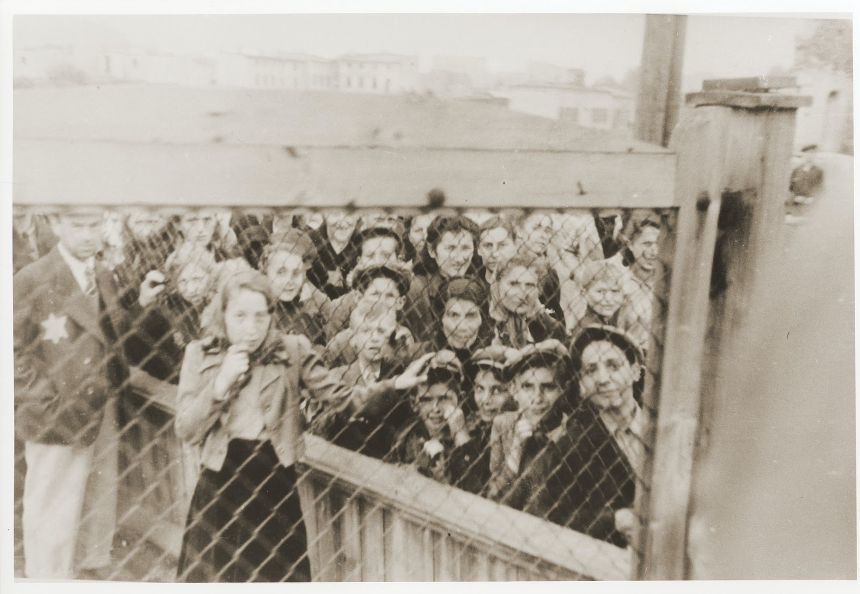
Women and children who have been selected for deportation, are photographed through the wire fence of the central prison.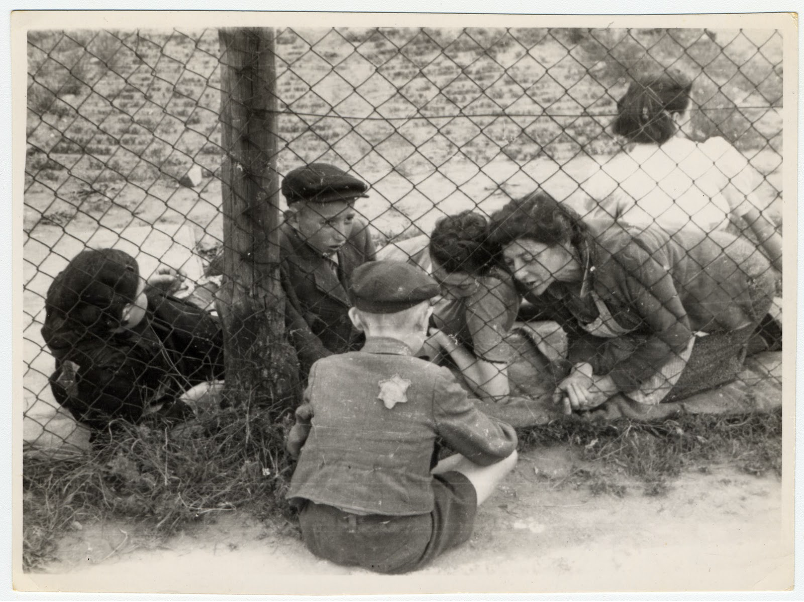
A child who has been selected for deportation, bids farewell to his family through the wire fence of the central prison.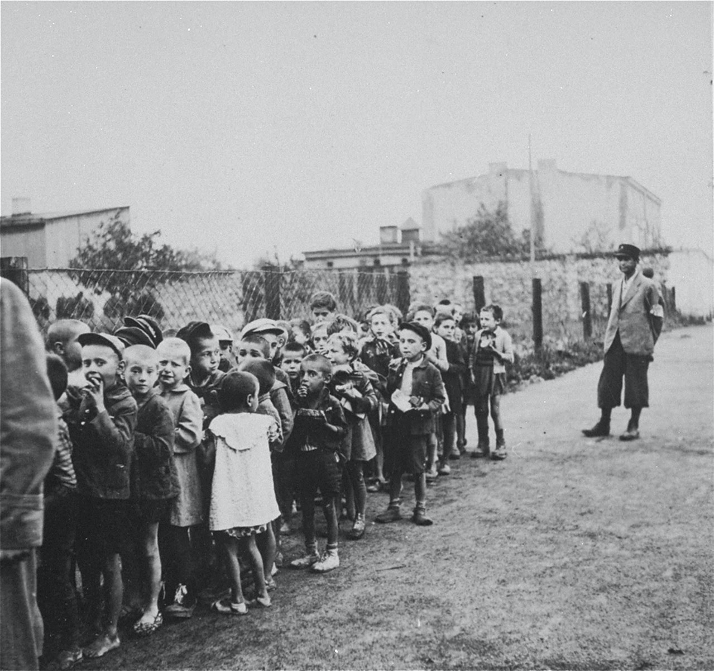
Children from the Marysin colony who were rounded-up during the “Gehsperre” action march in a long column towards a deportation assembly point
The fear of liquidation in the ghettos constantly hung over the Jews, waiting for German soldiers to take them away, as Emmanuel Ringelblum writes, “as sheep to slaughter.”
The Jewish Ghetto Police, a collection of Jews tasked by the Nazis to enforce order in the ghettos, also aided in the deportation process. SS officials and the Jewish Ghetto Police pushed Jews to death in a very systematic manner. In cases of liquidation of a whole ghetto, such as the Warsaw Ghetto, they would section off each block and collect every Jew in sight. Should any resist, they would violently force them to get on the train, sometimes killing them in the process. The USHMM states that, “To lure Jews out of hiding, the German authorities often resorted to announcements that the deportations were over and those who not been deported would receive food. Starving and unaware that they would be transported to their deaths, some Jews reported and they too were deported to Treblinka.” Ringleblum touches upon this in his diary, speaking of the “‘incomprehensible brutality’ of the Jewish Ghetto Police who administered the Aktion” (Lawson, 13).
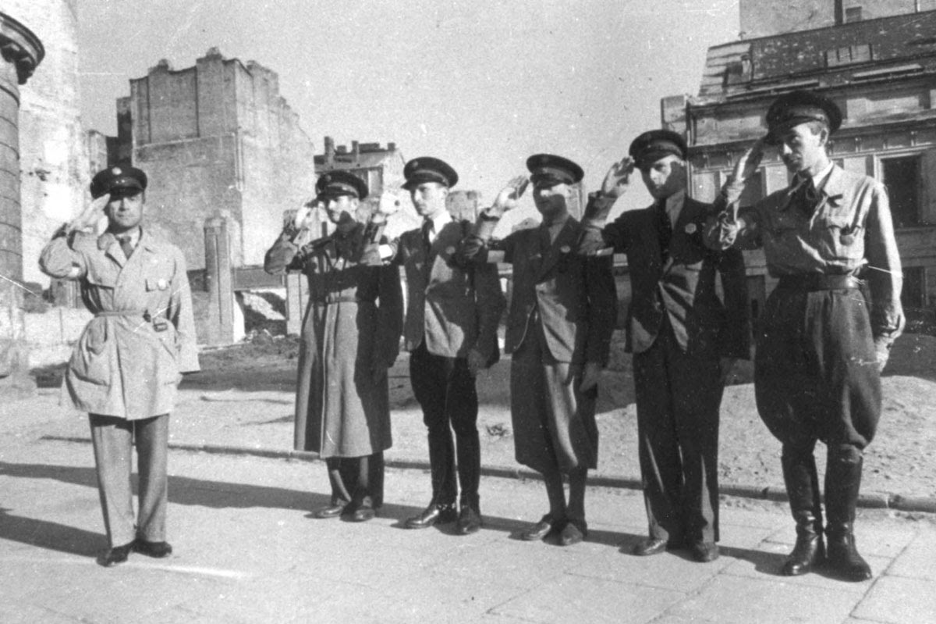
July 1942, a Roll-Call of Six Jewish Policemen in the Warsaw Ghetto, Poland 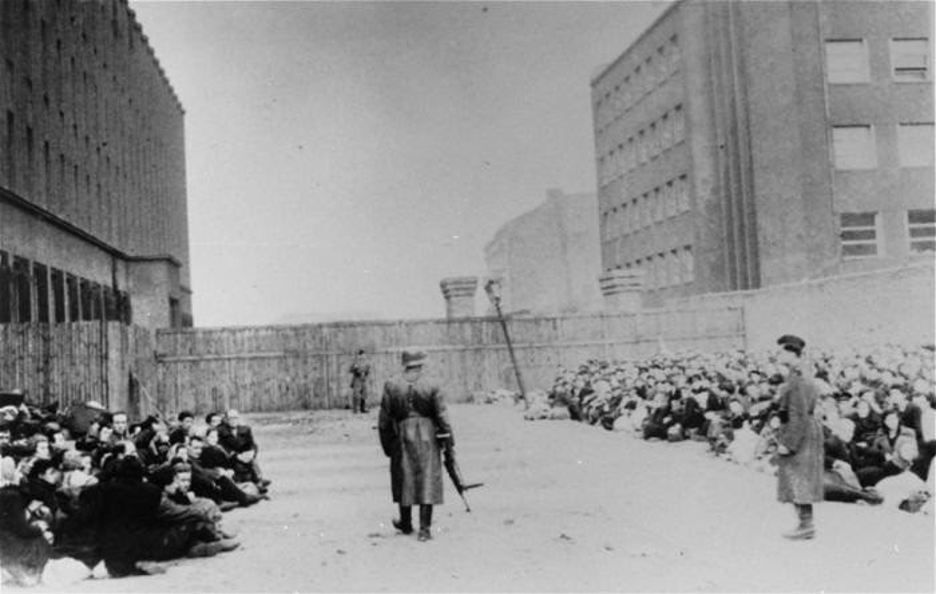
An assembly point (the Umschlagplatz) in the Warsaw ghetto for Jews rounded up for deportation. Warsaw, Poland, 1942–43
Warsaw Ghetto Uprising
There were several uprisings by Jews who had been confined to Ghettos during the Second World War. During the Lakhva Ghetto uprising in September of 1942 the inmates of the Ghetto attacked the walls and over a thousand escaped. However, most escapees were subsequently tracked down and killed. This uprising is considered to have been encouraged by Dov Lopatyn, the leader of the local Judenrat. He had discovered that nearby ghettos were being dissolved and wanted to preempt the Germans.
The Warsaw Ghetto Uprising occurred between April and May of 1943. Deportations from the Warsaw Ghetto had been occurring since 1942 but in 1943 the Jews living in the ghetto discovered the true nature of the deportations: people were being taken to death camps and killed. By this time there was a relatively small population remaining in the Warsaw Ghetto.
Suddenly I felt beyond life and death. I felt sure we were going to die, but I felt a part of the stream of Jewish History.
Alexander Donat, quoted in Eisenberg, 397
The main Jewish resistance groups were the Jewish Combat Organization (ZOB) and the Jewish Military Union (ZZW) the later of which was made up primarily of former Polish army officers. On April 19th, 1943, the Germans entered the Ghetto to get the daily quota of people for deportation. Instead, they were fired upon by Jewish Resistance fighters. The Jewish fighters used hand grenades and Molotov cocktails to bog down the Germans advance. On this day a Polish and Jewish flag were raised on one of the taller buildings in the Ghetto, and on the 20th the Jews received an ultimatum to surrender, which they rejected.
At this point the Germans began a tactic of methodically burning every house in the ghetto with flamethrowers. This allowed them to make slow advances. By the 29th the Jewish defenses had collapsed and by the 8th of May both resistance organizations had been defeated. The Ghetto had been largely burned to the ground and, after German clean-up operations, 56,000 Jews had died. The Germans claimed that under twenty of their own soldiers had been killed but this is disputed. Many Jews used the cover of the uprising to escape into Aryan Warsaw and passing as Poles.
The reaction of Jews inside the ghetto but not actively involved in the resistance seems to generally be one of jubilance. In the testimony of one survivor, Alexander Donat, states after the first battle, that, “Although we were all doomed to a terrible death, we were gripped by a strange ecstasy. We embraced and congratulated one another; women cried and laughed; people began to sing psalms in a low voice, and one grey-haired man spoke the blessings aloud: How wonderful it was to have lived in such times!” He goes on to state, “Suddenly I felt beyond life and death. I felt sure we were going to die, but I felt a part of the stream of Jewish History” (Eisenberg, 397).
The people in this apartment seem extremely happy that the uprising is taking place. It is like their sense of honour and pride has finally been returned to them in their final moments. They already believed their deaths were certain and this was an act of agency. The reaction of people outside the ghetto tended to be one of horror at the unfolding situation. One Polish witness wrote, “There were Germans who spat at the sight and turned away, they could no longer endure the horror. A Polish Woman stood at the window, stripping the garments off her body, and shouting that there was no God in Heaven, if he could see all this and remain silent. I felt my legs would no longer support me and I was compelled to move away” (Kulkielko in Eisenberg, 400).
The reaction to the uprising then seems to have been much more positive inside the ghetto than outside. Presumably, this is because, while the people in the ghetto were aware of the horrors going on, the people outside the ghetto were only altered to it by the uprising itself. Of course, the Polish resistance in Warsaw would have their own uprising in 1944.
Mordechai Anielewicz was the leader of the Jewish Combat Organization and is remembered as a hero for his actions during the uprising. He organized and rallied the ZOB and was eventually killed with the rest of the ZOB command when their bunker was discovered by the Nazis.
Generally the Warsaw Ghetto Uprising is seen as the most heroic act of Jewish resistance against the Holocaust to take place during the Second World War. The events have attracted significant attention from historians and others as evidence of defiance in the face of overwhelming odds. Though the battle was a significant military defeat for the Jewish Resistance the mere ability to mount resistance at that juncture is astounding. It also shows part of why the Germans were interested in keeping the nature of their mass murder obscured. Once people know that they are going to be killed they become much more difficult to control.
For Further Reading
Secondary Sources
- Adler, Eliyana R. “No Raisins, No Almonds: Singing as Spiritual Resistance to the Holocaust.” Shofar: An Interdisciplinary Journal of Jewish Studies 24, no. 4 (2006): 50-66.
- Dawidowicz, Lucy S. The War against the Jews, 1933-45. New York: Holt, Reinhart, and Winston, 1975.
- Flam, Gila. Singing for Survival : Songs of the Lodz Ghetto, 1940-45. Urbana: University of Illinois Press, 1992.
- Kassow, Samuel. Who Will Write Our History? : Emanuel Ringelblum, the Warsaw Ghetto, and the Oyneg Shabes Archive. Bloomington: Indiana University Press, 2007.
- Lawson, Tom. “‘Like Sheep to the Slaughter’: Debates on Jewish Responses to Nazism.” In Debates on the Holocaust, 235-69. Manchester: Manchester University Press, 2010.
- Mark, Ben. Uprising in the Warsaw Ghetto. New York: Shocken Books, 1975.
- Trunk, Isaiah. Judenrat: The Jewish Councils in Eastern Europe Under Nazi Occupation. New York: Macmillan, 1972.
Primary Sources
- Czerniaków, Adam. The Warsaw Diary of Adam Czerniakow : Prelude to Doom. New York: Stein and Day, 1979
- Donat, Alexander. The Holocaust Kingdom: A Memoir. Washington: USHMM, 1999.
- Donat, Alexander. “A Survivor’s Report from One Shelter.” In Azriel Eisenberg, ed, Witness to the Holocaust, 395-99. New York: The Pilgrim Press, 1981.
- Korczak, Janusz. Ghetto Diary. New York: Holocaust Library, 1978.
- Kulkielko, Renia. “A View from the Outside.” In In Azriel Eisenberg, ed, Witness to the Holocaust, 399-402. New York: The Pilgrim Press, 1981.
- Person, Katarzyna, ed. The Ringelblum Archive: Underground Archive of the Warsaw Ghetto. vol. 1 . Warsaw: Jewish Historical Institute, 2017.
- Ringelblum, Emanuel. “Last Letter from the Warsaw Ghetto.” In Paul Mendes Flohr, ed, The Jew in the Modern World: A Documentary History, 765. New York: Oxford University Press, 2011.
- Ringelblum, Emanuel. Notes from the Warsaw Ghetto; the Journal of Emmanuel Ringelblum. New York: Schocken Books, 1974.
- Ross, Henryk. “The Lodz Ghetto Photographs of Henryk Ross.” AGO. Accessed November 12, 2020.
- “Rumkowski’s Address at the Time of the Deportation of the Children from the Lodz Ghetto, September 4, 1942.” in Arad, Y., Y. Gutman, and A. Margaliot. Documents on the Holocaust: Selected Sources on the Destruction of the Jews of Germany and Austria, Poland, and the Soviet Union, 283-4. Amsterdam: Elsevier Science, 2014.
- Tory, Avraham. Surviving the Holocaust : the Kovno Ghetto Diary. Cambridge, Mass: Harvard University Press, 1990.
[1] Emmanuel Ringleblum is responsible for the creation of one of the most valuable collections of historical documents, known as the Oyneg Shabes Archives. He received his PhD in History at Warsaw University, and had published many scholarly articles by 1939. Once the war broke out and he was forced into the Warsaw Ghetto, he became very active in welfare and cultural programs in the Ghetto. He founded YIKOR, a group devoted to Yiddish culture, and collected documents for the Oyneg Shabes Archives. He was caught with his family in hiding in 1944 and was killed. While only a portion of the vast archives survived the war, the Oyneg Shabes archives still give historians a much deeper understanding of daily life in the Ghetto in German-occupied Poland.
[2] The Paper Brigade describes a group of Jews who smuggled in rare and forbidden books. The Nazis established a program called Einsatzstab Rosenberg, “an organization that was to study the Jews after they had been exterminated.” Because the Germans could not understand many of the documents they were going through, they created a “forced brigade” of Jewish artists and academics. This group eventually became known as the Paper Brigade, and they managed to save many important Jewish documents. While some members included documents to save that the Germans had not wanted to include, others snuck documents into the Ghettos and hid them. Their rationale was that the Germans would eventually lose the war, and afterwards they could retrieve them from underground in the ghettos. As a result of their bravery, they saved many important YIVO documents. Shmerke Kaczerginski has said that, “ Ghetto inmates looked at us as if we were lunatics. They were smuggling foodstuffs into the ghetto, in their clothes and boots. We were smuggling books, pieces of paper, occasionally a Torah scroll or mezuzahs.”
