By Emma Melton ’24 and Anika Banerjee ’24
The Nazis targeted many populations: in addition to Jews, they executed those they deemed biologically or socially inferior, political adversaries, Roma, Soviet Prisoners of War, and homosexuals. Studying the larger framework of Nazi racial and eugenic policies helps to understand the interconnectedness of prejudice and programs of mass murder. To read more about the Euthanasia Program and other victims, see below and find additional resources at the bottom of the page.
Euthanasia Program: Disguised, Systemic Murder
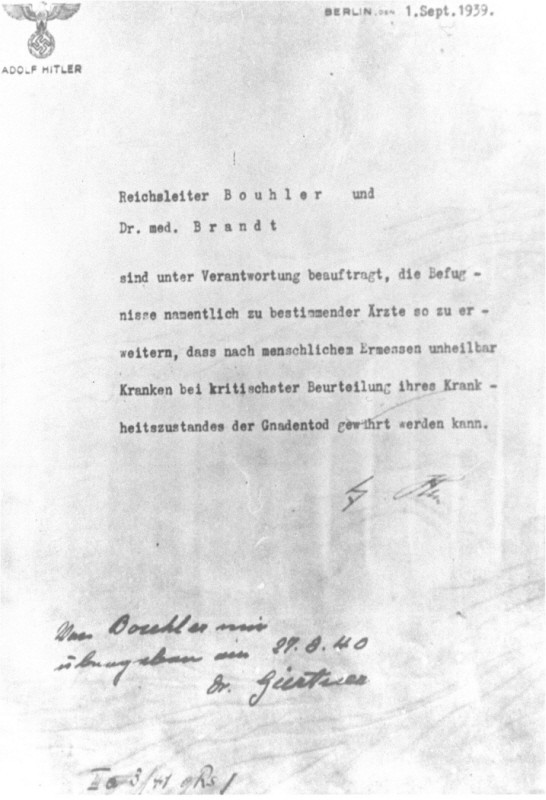
The Euthanasia Program foreshadowed the mass murder of Jews and other victims by way of carbon monoxide gas. It began as an effort to cleanse the German gene pool of any mental or physical disabilities. Hitler approved this program by personally clearing doctors, like Reichsleiter Bouhler and Dr. Brandt, M.D., to murder people according to their “human judgement” on the people’s diagnosis. (Did they believe it to be curable or not?) His letter was written on the first of September in 1939. This program preceded the systematic murder of Jews, and paved the way for the Nazis efficient killing machine.
What was the Euthansia Program?
- Eu in Greek means “good”
- Thanatos means “death”
- In other words, Euthanasia was to mean “painless death.”
The systematic murder of institutionalized patients with disabilities in Germany. It started two years before the Holocaust (the genocide of Jews and other victims). It aimed to eliminate what eugenicists and their supporters considered “life unworthy of life” (USHMM).
The Nazis, however, “participated in the murder of Jews, Sinti, and Roma; the disabled; the mentally ill; and other “unfit” persons” under euphemisisms that conveyed the improving of “public health and Rassenhygiene (racial hygiene, the German version of eugenics)” (US National Library of Medicine). They made it seem as though they were improving health through painless deaths, but their program was anything but painless.
Across the final days of the Holocaust, they killed a “wider range of victims, including geriatric patients, bombing victims, and foreign forced laborers” (USHMM). Similarly to other killing programs in the Holocaust, the Euthanasia program exponentially increased in activity as Hitler’s regime began to fall apart. This occurred as a consequence of efforts to kill a much larger population in a much shorter time span.
Why is the Euthanasia Program significant to the Holocaust as a whole?
As if a play, Nazis were able to rehearse their persecution of Jews and their genocidal policies. They were able to craft justification to exterminate those that they deemed were “unfit” to live, like the Jews and Roma. The Final Solution mass-killing was performed by both gas chamber murder and an accompanying crematoria. Those that impressed the Nazi government with the T-4 program also were the German faculty stationed at Operation Reinhard killing centers: Bełżec, Sobibór, and Treblinka.
How did it start?
In the spring and summer of 1939, the program began via secret, organized murder of children who were disabled. This program was led by Philipp Bouhler and Karl Brandt, after receiving approval from Hitler, himself. It started with a decree from the Reich Ministry of the Interior that all physicians, nurses, and midwives were required to report if newborn infants or children under three “showed signs of severe mental or physical disability” (USHMM). This was in August of 1939. Come October, parents were encouraged to admit their children to “pediatric clinics” that functioned as killing wards. Children would often die from medication overdose or starvation. Over time, the scope widened to youths up to the age of 17.
What are the main Euthanasia Programs?
Aktion T4. The “T4” comes from a code-name referring to the secret address of the headquarters, based in Berlin: Tiergartenstrasse 4. To others, the euthansia program was hidden under a euphemism, for it implied “mercy killing;” however, the T-4 program did not align to the ideas of euthanasia.
So what happened? How was this program carried out?
1939. Fall. T-4 planners gave questionnaires to public health officials, public and private hospitals, mental institutions, and nursing homes for the chronically ill and aged. The wording and instructions gave the impression of a statistical survey. In actuality, patients were being assessed on their ability to work and their health; it looked at if there were any neurological disorders, if they were German or related by blood, if they were convicted — or deemed insane, and those who had resided in an institution for more than five years.
1940. Winter. Workers for the program began to remove patients who were deemed to be enrolled in the program. They were taken to gassing installations for killing. Patients would arrive and be gassed with pure, bottled carbon monoxide gas in buildings that were disguised as shower facilities. Families received an urn of ashes — a common pile was formed from those that perished — and a note explaining a falsified cause of death.
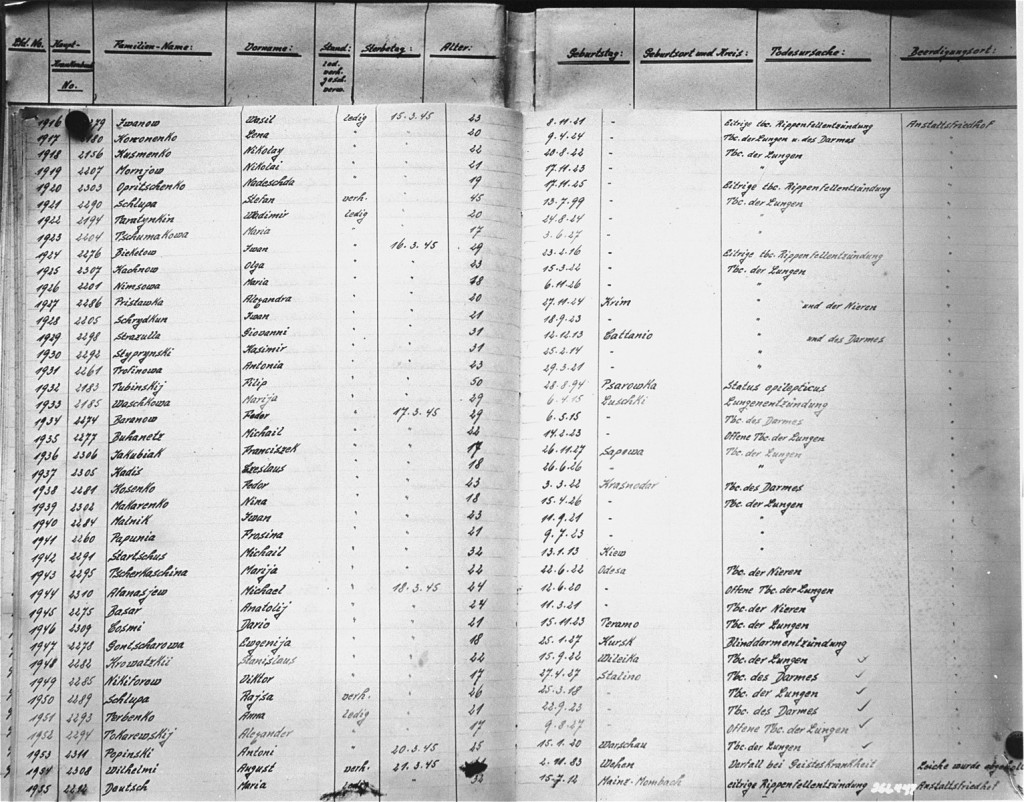
According to T4’s own internal calculations, the “euthanasia” effort claimed the lives of 70,273 institutionalized mentally and physically disabled persons at the six gassing facilities between January 1940 and August 1941.
USHMM
“Hitler’s 1939 decree allowing physicians to decide that certain individuals ‘be accorded a mercy-death.’ These patients included those with schizophrenia, the criminally insane, and the chronically hospitalized.” (The American Journal of Psychiatry).
The Euthanasia program was a mission to eliminate all people that did not fit the idealistic Aryan race that the Nazis were trying to mold. Brandenburg, Grafeneck, Hartheim, Sonnenstein, Bernburg, and Hadamar were six facilities designated as Euthanasia killing centers.“The Hadamar Psychiatric Institute near Wiesbaden, Germany, code-named “Facility-E,” was refashioned for use as a psychiatry euthanasia facility in November 1940. From mid-January 1941 under Dr. Ernst Baumhard’s direction, with a staff of approximately 100, busloads of patients arrived daily at the killing operation. The patients were offloaded, weighed, photographed, and led to the gas chamber disguised as a shower room in the cellar. At least 10,000 mentally ill adults were gassed and cremated at Hadamar in the first 9 months of 1941” (The American Journal of Psychiatry).
Remembering the Euthanasia Program
An example of this comes from Deutsche Welle (DW): “Sigrid Falkenstein, for instance, who was born in 1946, was shocked when she learned that her aunt Anna Lehnkering had been murdered in the Grafeneck euthanasia facility.”
In my family, we never talked about my aunt. I now know that many families were and still are caught in a vicious circle of repression, silence and taboos. One reason was that the eugenic ways of thought, which stressed ‘racial hygiene,’ didn’t disappear with the end of the war. For a long time, victims, survivors and their families were stigmatized in both West and East Germany. By contrast, most of the perpetrators got off scot-free and continued their careers. My impression is that there has been a positive turn in the culture of remembrance concerning the victims of ‘euthansia’ and forced sterilization.
Sigrid Falkenstein in Deutsche Welle
The discovery of the Euthanasia program shocked people— especially those who witnessed or experienced the atrocities of the Holocaust— as they learned that the Program began prior to the systemic Holocaust persecution. There are so many unknowns surrounding Euthanasia in terms of accountability, as Falkenstein mentioned. Along with the rest of the Holocaust, it tore people away from their loved ones and there was a stigma created around the subject. People were unable to discover or even seek the truth because of the risk of defying the status quo.
Accounts like Falkenstein’s illustrate the societal injustice surrounding to Holocaust and demonstrates how it remains an issue to this day.
The Euthanasia Program in the Holocaust
German camp personnel were often made up of T-4 program staff. Since the T-4 operation was motivated by the same desire to cleanse Germany, staff was readily available to use their expertise with the killing process (gassing and cremation). When the war began, they applied similar methods of murder to other populations.
What were the victimized populations?
During the Nazi regime, persecution impacted a variety of groups. Some people were targeted due to racial causes, like both Jews and Roma. Those with disabilities were targeted because they were seen as a financial burden to Germany. Other groups were preyed upon due to being political opponents, homosecuals, “asocials,” and Jehovah’s Witnesses, as they were seen as “a danger to the ‘national community’” (USHMM).
All of these aforementioned groups were targeted by the program for mass murder. However, the T-4 program, lasting until the end of World War II, primarily included disabled children and adults, geriatric patients, bombing victims, and foreign forced laborers. Only during the war did the victim group expand to Poles, Soviet POWs, Soviet citizens, and other groups.
- Roma and Sinti were viewed as racially inferior, and therein were targeted for murder.
- Mentally and/or physically disabled people were seen as useless and a financial burden, and therein were targeted for murder.
- Poles were viewed as less than in comparison to other Slavs, and therein were targeted for murder.
- Jehovah’s Witnesses, accused homosexuals, and asocials (“…people who did not conform to [Nazi] social norms” via the Holocaust Memorial Day Trust) were viewed as impure or poor for the German population, and therein were targeted for murder.
What was the gas made of?
Victims were murdered with carbon monoxide gas. At every Operation Reinhard killing site, victims were murdered with this gas. It was created by exhaust from large motor engines and then was funneled into stationary gas chambers for consumption of the lungs.
Where was the gas most used? / What was Operation Reinhard?
The gas was predominantly used for killing at Operation Reinhard sites. Operation Reinhard was the planned, systematic murder of Polish Jews by the German government. Three concentration camps — Bełżec, Sobibór, and Treblinka — were the killing sites where Jews were sent to be murdered in large groups.
Aside from the Jews, a major population persecuted and murdered by the Nazis were the Roma.
Nazi Genocide of the Roma
Who are the Roma?
Roma are of Northern Indian descent (around Punjab), they migrated to Europe between the 8th and 10th century C.E.. Historically, Roma had distinct cultural traditions from Europeans, and overall, hold a lifestyle very different from that of a European. They had a more radical form of governing themselves and their law which differs greatly from other Europeans. Walter O. Weyrauch emphasizes “that a view of Gypsy law as culture or folklore undervalues the power it exerts on the community and tends to ignore the essentially legal processes of evidence giving and adjudication” (Gypsy Law: Romani Legal Traditions and Culture).
Roma are often the forgotten victimized population of the Holocaust since they were excluded from the Nuremberg Trials. The abuse and murders of Roma were not acknowledged until 1982 when some German authorities spoke of them.
How and why were the Romas victimized?
The Roma were seen as inferior to the Nazis. They failed to adhere to the “normal” mold of what Nazis expected of people. This concept, formulated by the Nazis, characterized Roma, and other persecuted groups, as ‘asocial’. “By the late 1930s, Nazi racial ideology had been extended to encompass the notion that, like Jews, Roma were also of ‘alien blood’ and a threat to the racial strength of the ‘Aryan master race’” (The Conversation). Roma were seen similarly to how Jews and Homosexuals were seen by the Nazis. They were seen to mar the perfect genetic potential the people had. Their Indian roots had an impact on their physique, and the way they conducted themselves also did not align with the ideal Nazi person.
The Roma population was a group of people who were targeted by the Nazis during the Holocaust because they were believed to be in need of “ethnic cleansing.” The peak of Roma killings was reached in 1944 from July 31-August 2 where the liquidation of Zigeunerlager began at Auschwitz-Birkenau. Over the span of those days, 3,000 Roma were murdered.
Some of the camps that the Roma were sent to to be exterminated were “Auschwitz-Birkenau, Chelmno, Belzec, Sobibor, and Treblinka” (USHMM).
In terms of the treatment of Roma, it does not greayly differ from that read in Jewish documentations of the camps: “The Roma in the ‘Gypsy camp’ at Auschwitz-Birkenau were crowded into a few barracks where hundreds died from malnutrition, epidemics, medical experiments, forced sterilization and forced labour” (UN and the Holocaust). They were treated like animals, which was common for Nazis, they alienated the human qualities from people making their abuse “justifiable.” Nearly ¼ of the total Roma population was murdered in the Holocaust, and this speaks to the disregard for preserving any semblance of their being.
Another reason why Roma were victimized alongside the Jews was because the Roma population were stereotyped as thieves and looters, which “vindicated” the actions of the Nazis. “Late in 1938, Heinrich Himmler announced in a circular that he would ‘solve the Gypsy question through the nature of that race’. The theories of Nazi scientists and politicians remained, however, contradictory until 1942/43. On the one hand, the Roma‘s Indian descent classified them as ‘Aryans’, but on the other hand politicians and scientists wanted to prove their ‘foreign race’ in order to legitimise their persecution” (Project Education of Roma Children in Europe). Aside from them “tarnishing” the Aryan idealist persona the Nazis were seeking, Romas were seen as foreigners. Not citizens of their country, but aliens, or invaders rather.
Roma Experiences of the Holocaust
My mother, father, and I were collected from our town in Zalaegerszeg, Hungary. I was only nine years old, we were taken by train to Komárom. The train ride was a humiliating experience: crowded and cold, men and women all together with no toilet and almost no food
József Forgács
Maria Sava Moise was born in Iasi, Romania to Roma Parents. She was one of four children and grew up in a neighborhood among Roma and Romanian people. Moise’s father worked at wineries across the countryside of Moldova, and he was also a singer. Since her parents were unable to afford education for Maria and her siblings, the children picked grapes for the wineries to help generate a family income. In 1942, Maria got married, and following that, her father was drafted to become a Romanian soldier and fight the Soviet Union.
Later in 1942, Maria’s family — her husband, mother, and some of her siblings, and she — were abducted by the police in the early morning and taken from their homes to a Transnistria. When she arrived, she was unsure of what was going to happen to her, she saw military soldiers and large crowds of Romanians, Roma, and Jews, and Nazis sent them to march. They walked for two days, if they wanted to drink from puddles on the ground, they’d be shot. Those who could no longer walk were left to die. They arrived at houses where they could live, but her family grew weaker, and more people began to die. Maria’s sister died soon after their arrival. Her father returned from war and applied to get Maria and the rest of her family back, but there was a lot of difficulty. Maria’s husband was able to escape captivity, and Maria’s Father, who was stationed by where they were being held smuggled Maria and her remaining siblings back to Romania.
She was a Roma, and it was clear to see that the way this marginalized population was treated, was no different to that of the Jews. They were still starved, murdered, captured, and were seen to be void of all humanity. Maria’s family was transported in cattle cars, expected to survive without basic human needs (water, food, rest) and were killed for the slightest missteps. Maria’s story as a Roma also encapsulates all these terrors that were also put upon the Jews. Maria spoke with composure and little emotion in her recording, when referring to the death of her sister, she said “My mother said here’s some clothes. Take them for the girls to wear, and my father said, ‘Don’t give clothes for both, just give me clothes for one,’ and my mother realized she was no longer alive.” Her mother was not notified of her daughter’s death directly, it was mentioned in passing.
Testimony via Voices of the Victims)
József Forgács, another Roma Holocaust survivor, was deported from Hungary from which he was packed into a crowded train car to Komárom. “My mother, father, and I were collected from our town in Zalaegerszeg, Hungary. I was only nine years old, we were taken by train to Komárom. The train ride was a humiliating experience: crowded and cold, men and women all together with no toilet and almost no food.”
When they arrived, they were separated into groups where their hair was cut and they were unrecognizable. After a week, all those who were above the age of fifteen were taken away, and this was the last time Forgács, who was nine years old at the time, saw his father. Forgács was then moved to an Austrian labor camp and had to leave his mother behind. To this day, Forgács cannot remember where he was held, but it was most likely a sector of the Mauthausen concentration camp complex. “I did not really know at the time what was happening to me; day after day I had to clean the floors of that building. They gave us food only once a day, and it was either dried bread or some soup which was more dirty water than soup.”
After quite a while at this, the Soviet troops liberated their camp. They were given freedom, but they didn’t know what to do, they were unsure of how to navigate the world alone.
They walked hundreds of miles, begging for shelter and food from people speaking a strange language. They slept anywhere they could find, usually outdoors in a field. Many children died like this on the road.
József Forgács
They finally arrived at Sopron, a city bordering Hungary and Austria where he could speak the language and finally felt at home. When he returned to his hometown, Zalaegerszeg, he found that his family home was destroyed, and there was no semblance of the life he had prior to the concentration camp. Forgács was separated from his family at such a young age, and they were never reunited. Even though his time in a labor camp was short, it changed the trajectory of his life entirely. Forgács rebuilt his life in Zalaegerszeg, but since he did not spend a full year in the concentration camp, he was never compensated for by the state.
Testimony via Open Society Foundation.
Challenges of Commemoration
It is unknown how many Romas were murdered during the Holocaust, however, it is estimated to be around 300,000 to 500,000 (some even estime about 1.5 million Roma to have been killed) people. So while a large portion of Romas were killed during the Holocaust, it is often neglected because the volume of Jews was simply larger. This also means that the Roma who came out alive from these camps were smaller, and their perspectives were published and stories were told on a much smaller scale than the Jews. Roma were not as well known, this made giving the necessary commemoration difficult, people were (and still are) blind to the cruelty this population also had to face. These documented stories from Roma survivors are crucial for recognizing their experience and importance in the Holocaust.
Rita Prigmore was a Roma Holocaust survivor. In 1942, Prigmore’s mother was going to be sterilized (to try and curb the production of any more Roma), but then she was found to be pregnant with twins. They cancelled her abortion because the Nazis wanted to use the twins for experiments. Her mother was forced to sign a contract that gave the Nazis a right to perform medical experiments on the twins right after birth otherwise they would all be sent to Auschwitz. Rita’s twin passed away, and Rita was reunited with her mom two years after she was born. Rita has now dedicated herself to collecting evidence proving that her and her family were in fact victims of the Holocaust.
“We Gypsies do not have a country of our own and we do not strive for it. We want to be fully fledged citizens in the countries we live in and have been living for generations. We Gypsies want to work, live in dignity, and have chances for education and a dignified life. My motto for the Roma Genocide Remembrance is ‘Remember the past, act in the present, and change the future.’ I am sure that living together is the future” (Open Society Foundation).
People like Rita were victims of the Holocaust and are fighting for recognition. Roma persecution has been overlooked because their population was not as large as the Jews, however, this does not devalue their stories or experiences.
Additional Sources
Scholarly Sources:
- Arnds, Peter. “On the Awful German Fairy Tale: Breaking Taboos in Representations of Nazi Euthanasia and the Holocaust in Gunter Grass’s Die Blechtrommel, Edgar Hilsenrath’s Der Nazi & Der Friseur, and Anselm Kiefer’s Visual Art.” German Quarterly 75, no. 4 (Fall, 2002).
- Friedlander, Henry. Origins of Nazi Genocide: From Euthanasia to the Final Solution. Chapel Hill: The University of North Carolina Press, 1995.
- Kelso, Michelle, and Daina S. Eglitis. “Holocaust Commemoration in Romania: Roma and the Contested Politics of Memory and Memorialization.” Journal of Genocide Research 16, no. 4 (2014): 487–511.
- Knittel, Susanne. The Historical Uncanny : Disability, Ethnicity, and the Politics of Holocaust Memory. New York: Fordham University Press, 2014.
- Milton, Sybil. “Sinti and Roma in Twentieth-Century Austria and Germany.” German Studies Review 23, no. 2 (2000): 317-31.
- Preda, Caterina. “Artistic Memorialization of the Roma Holocaust in Romania: Rendering Visible the Historical Trauma and Documenting the Suffering.” Holocaust. Study & Research / Holocaust. Studii Şi Cercetări, no. 2019 (January 2019): 123–48.
- Pogány, István. “Memory and Forgetting: The Roma Holocaust.” In Gready, Paul, ed. Political Transition: Politics and Cultures. LONDON; STERLING, VIRGINIA: Pluto Press, 2003.
- Rose, Romani. “Remembrance and Beyond: The Roma and Sinti during the Holocaust and Today.” UN Chronicle 43, no. 4 (2006): 66–68.
- Weiss-Wendt, Anton, ed. The Nazi Genocide of the Roma: Reassessment and Commemoration. New York: Berghahn Books, 2013.
Testimony and voices of Roma:
