By Addie Anderson ’24 and Luke Mitchell ’23
Refugee: a person who has been forced to leave their country in order to escape war, persecution, or natural disaster.
During World War I, occupations, such as Russia in East Prussia and Germany’s occupation of Belgium, northern France, Poland and Lithuania, caused many to flee their homes and become minorities and refugees in new locations, many of whom were persecuted in these places by being accused of aiding the enemy for having come from “enemy” territories. After the war, many new territorial lines were created with victors adding fallen empires’ territories to their own states, such as Czechoslovakia and Poland, redrawing much of Europe and placing people under new governments and forcing new identities upon them. Thus, when World War II and the Holocaust caused an influx in refugees, the crisis was expanded.

As the Nazi rose to power in Germany they began pushing antisemetic laws and regulations on Jews. Much of these encouraged Jews to flee early on in Nazi power before concentration camps and mass killings began. The answer to the Jewish question for the Nazis at the beginning, it seems, was potentially emigration: Nazis first promoted the flight of many Jews to nearby countries, but this created problems as emigration was not easy because obtaining visas was difficult and the demand for them only grew after Kristallnacht in 1938. The rise of Nazism and this mass emigration only fueled what would become an even larger refugee problem as the Nazis brought nearby countries into their fold and eventually further pushed people to flee as mass killings began.
During the Holocaust over 340,000 Jews emigrated from Germany and Austria alone. Many ended up in other Germany occupied territories, therefore not escaping their fates, while others faced limitations to safety due to quotas and restrictions posed on immigration to countries like America, Shanghai, and Palestine. British Mandate for Palestine, for example, placed restrictions on Jewish immigration to Palestine, and even sharply limited quotas after 1935 and again as a response to the Arab Revolt.
Immigration to Palestine remained extremely limited until the State of Israel was established in May of 1948, and over the next few years over 140,000 Jewish Holocaust survivors immigrated there. The US, on the other hand, set forth the Johnson Reed Act of 1924 which set quotas and limited immigration by distributing a specific number of visas each year for each country, in order to privilege “desirable” immigrants from Northern and Western Europe, therefore preventing many from Eastern Europe, where the strongest prosecutions were occurring, from fleeing to America. After the war the United States let 400,000 displaced persons enter the US, about a fourth of whom were Jewish Holocaust survivors.

Leaving for the West
As refugees seeking to escape the Nazi regime increased, many attempted to flee West into England, France, countries surrounding them, and oversees to the United States and South America. While millions of refugees fled to other countries, immigration was not always easy nor promised. In March of 1938 when Germany annexed Austria and brought it into Nazi Germany it became apparent that the “refugee question” needed to be answered as thousands of Jews hoped to get off of the US waiting list to enter the country.
To address this crisis 32 nations gathered at the Evian Conference in France between July 6th and 15th of 1938 to share information and come up with a solution. Little, however, was accomplished in terms of increasing places for refugees to go as country after country gave reason for their inability to accept more refugees. The exception was the Dominican Republic, which offered to settle up to 100,000 Jewish immigrants. While only under a thousand made it there, the willingness of this singular, small country is an important insight into the racialization of Jews in different countries: in the Dominican Republic Jews, though a small fraction of the population, were integrated into the country, helping the agricultural scene there as contributing members of society.
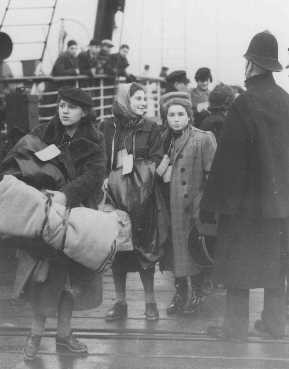
At this time, Britain held Mandate in Palestine, which was their portal to the Middle East and was therefore valuable economically and also formed a buffer against the Soviet Union’s expansion. In order for this Mandate to hold, the British worked to appease the Arab countries and in this case, that meant limiting the number of Jewish refugees they sent to Palestine. Not all immigration regarding Great Britain was off limits, however: one well renowned example was the Kindertransport. The Kindertransport, as a relief effort by British civilians, shows how while politically and through government regulations immigration was difficult, not all were apathetic or oblivious to the issue at hand, and were particularly empathic towards children in danger.
The Kindertransport was an operation to rescue almost 10,000 children from Germany, Austria, and Czechoslovakia and brought to Great Britain. Because it was limited to children up to the age of 16 many children had to leave their parents, most of which were not reunited with their parents. Once they arrived in the UK, they were housed in camps and then sent to their new families and homes. The experiences of these children varied greatly: some were placed in Jewish homes, and others in Christian households, some of which “attempted conversion” though “numerous Christian families who took great care to maintain the tradition of the children entrusted to their care” (Göpfert, p. 23).
The Kindertransport also faced logistical issues, including shortage of funding and personnel, as well as the need for Kinder to transfer to different homes due to various circumstances such as deterioration of the communities and inability of care by the families. Because of the limited number of children allowed, not all children could be taken and had to find other means of seeking refuge. As Irving Bienstock, a German born Jewish boy who ended up in Holland and later the United States but whose extended family perished in the Holocaust, said, “England decided to take 10,000 Jewish children from Germany and Austria. My mother registered my sister and I with the Jewish Community, to be among the children that would go to England. For some reason we were not taken” (Irving Bienstock Oral History Interview One, at Davidson College Special Collections, p. 5).
Other countries such as Sweden, Belgium, France, and the United States also attempted to rescue children. These countries account for at least 5,000 children, but only about 200 of these went toFrance. This low number (by comparison) is at least in part due to stricter guidelines for children selected: in France “sick or disabled children or even children with a learning disability were not allowed in France” (Maier, par. 10). When the Germans invaded Paris in 1940 about 250 Jewish children were transported to the United States in 1941. This process was extremely complicated, comprising of many organizations and differing ideologies resulting in a complex and complicated situation. In the United States the children were placed all over the country, but all in Jewish families. Despite this many French Kinder have stated they preferred their French orphanages over that of their foster families in America, to which one said: “I was happier at the orphanage in France than later with my foster family. We had lived in a room, ate together, exercised together. We had become a kind of family” (Maier, par. 43). Though there were small examples such as this in the United States, the government as a whole did not support refugees entering the country. For example, the Wagner-Rogers bill, which was an attempt to allow the entry of 20,000 German-Jewish refugee children into the States, was not supported in the Senate.

Fleeing East
While hundreds of thousands of German-Jewish refugees attempted to flee West in the years leading up to the war, many other refugees, which largely consisted of Polish-Jewish refugees of war, went East for protection. Forced from their homes, many of these refugees experienced extreme violence, starvation, strenuous journeys, forced labor, and oftentimes death.
Before the German invasion of Poland on September 1, 1939, Poland had the largest Jewish population in all of Europe with over 3.3 million Polish-Jewish citizens. These Jews accounted for more than 10% of Poland’s general population–which was also the highest in Europe. After the invasion, hundreds of thousands of Jewish and non-Jewish refugees escaped the German army and went into Eastern Poland.
These refugees, many of whom hastily left their homes without adequate supplies or a specific destination, had faith in the Polish army and hoped that their Soviet ‘allies’ would help aid their fight against the oncoming Germans; however, unbeknownst to these refugees, the Soviet Union and the Germans had formed a new secret alliance. On August 23, 1939, the Soviets and the Germans signed the Molotov-Ribbentrop Pact. This backroom deal was a non-aggression pact that partitioned Poland between the Germans and the Soviets (with the Germans controlling Western Poland and the Soviets controlling Eastern Poland). So while the Polish army thought they were retreating and regrouping in the East, in reality, these “Polish troops had jumped from the frying pan into the fire.”
On September 17, 1939, Soviet Foreign Minister Vyacheslav Molotov declared that the Polish government ceased to exist. Polish officials were forced to flee the country and establish a government-in-exile in London. As their homeland disappeared, these Polish-Jewish refugees faced an uncertain journey into exile.
While roughly 300,000 Polish-Jewish refugees remained in the German-occupied segment of Poland, a vast majority of the refugees lived in the Soviet section. Daily life for these refugees often consisted of fear, starvation, and harassment. During these initial years of occupation, the Soviet secret police would detain and deport hundreds of thousands of Polish-Jews and ship them to “posiolok” work camps in Siberia.
In an interview with Miriam Storch Lewent, a Polish-Jewish refugee and Holocaust survivor, she describes her family’s horrific deportation and life in Siberia. She recounts the night where she and her family, along with about twenty other families, were sleeping in a temple when the Russian army came in and took everyone onto the trains. Their journey in these overcrowded and unsanitary train cars lasted over six weeks until they finally arrived in Siberia to work for rations. Miriam’s story is not uncommon and showcases the brutal experiences of hundreds of thousands of Polish-Jewish refugees.
While a majority of the Polish-Jewish population stayed in either the German or Soviet-occupied regions of Poland, about 40,000 refugees continued their journey Eastward. Most of these Polish-fleeing refugees went to Hungary and Romania; however, about 15,000 went towards Lithuania. Of these 40,000 refugees, many sought to escape to the South through ships leaving Black Sea ports in Romania. A majority of the refugees desired to go to British-controlled Palestine; however, to complete the journey to Palestine, the ships had to refuel in Turkey.
Out of my whole family, only I made it to Palestine….When I was left alone in the world I was brought to Palestine. …When people ask me where I’m from, I say–from iron.
Child interviewed in Palestine, quoted By Henryk Grynberg in Children of Zion, p. 166
Turkish officials were not keen on helping these Polish-Jewish refugees unless they obtained permits from Britain (Yet the previously discussed quotas in the West largely prohibited Jewish immigration to Palestine). As with the case of the St. Louis in the West, in which 900 Jewish refugees were prohibited from disembarking in Cuba to escape antisemitic persecution in Germany, these quotas once again created a tragedy in February 1942. The Struma, a ship carrying 762 Polish-Jewish refugees, attempted to refuel in Turkey. After being denied access to dock in Istanbul, the boat sank (most likely from a torpedo hit from a Soviet submarine that mistook the ship for an Axis supply vessel). Only one passenger survived.

On June 21, 1941, the Germans broke the Molotov-Ribbentrop Pact by launching Operation Barbarossa and invading Soviet-occupied Poland. After the Germans and Soviets shifted from allies to rivals, the remaining Polish-Jews were subjected to further violence and terror. Many of the remaining refugees on the German side were sent to concentration and death camps while the refugees on the Soviet side were either left to fend for themselves or deported to labor camps in Siberia or other parts of Central Asia. Both borders became closed and heavily guarded, and therefore fleeing was no longer a feasible option. By the end of the war, Poland’s Jewish population had been decimated and approximately 380,000 total Polish-Jews were alive in either Poland, the Soviet Union, or in German-held concentration camps.
Although many Polish-Jewish refugees did not survive the war, those who did have remarkable stories. As with the kindertransport in the West, children in the East were grouped together and separated from their families. Although little is known about their experience, many of these children were eventually sent to Iraq and Palestine. Moreover, both Polish-Jewish children and non-Polish-Jewish children were separated since both groups had begun to be persecuted by the Nazis at this time. While in Palestine, several interviews were conducted of these children and their experiences. Their interviews were organized by Henryk Grynberg in his book Children of Zion. From these interviews we learn new details about the Eastern refugee experience: “Out of my whole family, only I made it to Palestine….When I was left alone in the world I was brought to Palestine. …When people ask me where I’m from, I say–from iron” (Grynberg 166).
A relative safe haven for Polish-Jews adults and families during the beginning stages of the war was Hungary. The Hungarian government was one of the few nations that accepted Jewish refugees. When Polish-Jews or Slovakian-Jews would enter Hungary, government officials would not turn the refugees over to German authorities. However, after the German occupation of Hungary in 1944, the Germans sent both Polish-Jews and Hungarian-Jews to be murdered at Auschwitz-Birkenau.
While many Polish-Jewish refugees fled to nearby neighboring allies, some refugees ended up in more surprising locations. One of the most unique of the Eastern emigration stories for Polish-Jews deals with the Shanghai Ghetto. In pre-war Shanghai, there was a small community of around 700 Sephardi Jews. In 1937, Japan, a strong German ally, occupied Shanghai; however, since Shanghai did not require a Visa for entry into the region (until 1939), thousands of Jews chose to immigrate to the region. With about 1,000 Jews arriving after 1933 and 17,000 more joining after Kristallnacht, Shanghai consisted of roughly 20,000 Jews by the time of the war. After the war had broken out, roughly 3,000 more Polish-Jewish arrived from Vilno, Lithuania after completing a long journey that consisted of trips across the entirety of Russia and sailing to Japan.
With all of these new Jewish refugees, the Japanese established a wall-less “Restricted Sector for Stateless Refugees,” commonly referred to as the Shanghai ghetto. These Jewish immigrants received aid from international Jewish agencies and found a common ground amongst the local Chinese residents who lived under similarly poor conditions. After the war, almost all of the Jews left the ghetto, yet the story of Shanghai serves as a rare and unlikely example of a largely successful population of Jewish refugees.
Further Resources for Learning about Jewish Refugee Experiences
Some refugees have attempted to work through their experiences through art, film, and other creative works. Others have contributed their memories and thoughts through oral interviews and written works. These valuable records and recollections offer us glimpses into the reality of the vast array of Holocaust refugee experiences.
Ink sketch on heavyweight paper depicting
men waiting in line to be given milk from
a metal milk can. Soldier stands guard nearby. Leo Yeni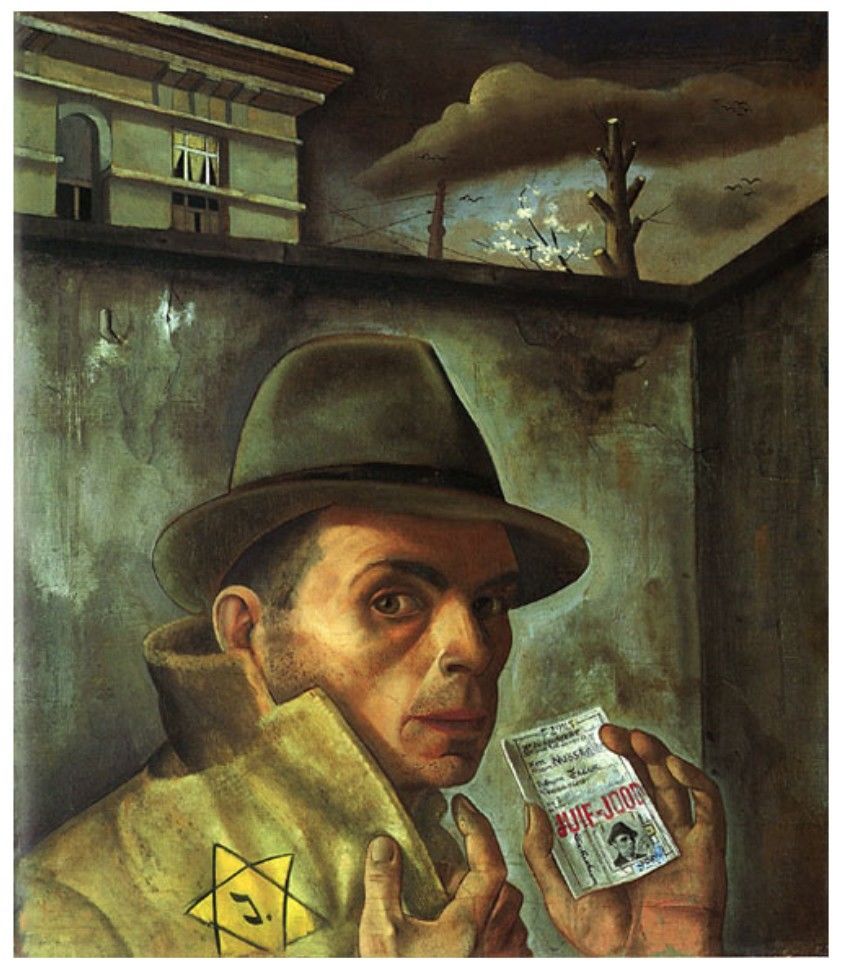
Self portrait with Jewish identity card, 1943. Felix Nussbaum

Music:
Film:
- 50 Children: the rescue mission of Mr. and Mrs. Kraus
- The Holocaust Encyclopedia: Refugees – Historical Film Footage
- Jewish refugees in the Dominican Republic
Personal accounts:
- Arendt, Hannah. “We Refugees.” The Jewish Writings. New York: Schocken Books, 2007.
- Life as a Refugee: Stories from the Jewish Survivor of Nazi Germany
- Goldberg, Morton. “Oral History Interview with Morton Goldberg.” United States Holocaust Memorial Museum, 18 Aug. 1999.
- Grynberg, Henryk. Children of Zion. Northwestern University Press, 1998.
- Kuzmak, Linda G. “Oral History Interview with Miriam Storch Lewent.” United States Holocaust Memorial Museum, 20 Oct. 1989.
- Contact Davidson College Special Collections for Irving Bienstock’s Oral History Interview
Scholarly sources:
- Caestecker, Frank, and Bob Moore. Refugees from Nazi Germany and the Liberal European States. New York: Berghahn Books, 2010.
- Culcasi, Karen, et al. “Contemporary Refugee-Border Dynamics and the Legacies of the 1919 Paris Peace Conference.” The Geographical Review, vol. 109, no. 4 (2019) p. 469.
- Gatrell, Peter. “Europe on the move: refugees and World War.” The British Library.
- Göpfert, Rebekka, and Andrea Hammel. “Kindertransport: History and Memory.” Shofar 23, no. 1 (2004): 21–27.
- Kraus, Paul. The Perpetual Refugee : Images of a Holocaust Child. NSW: Rosenberg Publishing, 2018.
- Maier, Lilly. “Rescued twice: the French Kindertransport Differences from and similarities to the British Kindertransport.” Science Open, 27 April 2020.
- Ogilvie, Miller. Refuge Denied: The St. Louis Passengers and the Holocaust. Madison: University of Wisconsin Press, 2006.
- Simone Gigliotti, and Monica Tempian. The Young Victims of the Nazi Regime : Migration, the Holocaust and Postwar Displacement. New York: Bloomsbury Academic: 2016.
- Stone, Dan. “On Neighbours and Those Knocking at the Door: Holocaust Memory and Europe’s Refugee Crisis.” Patterns of Prejudice 52, no. 2-3 (2018): 231–243.
- Stone, Dottie. “Eleanor Roosevelt and Refugees from the Holocaust: Beyond the Politics.” In Agency and the Holocaust, 87–102. Cham: Springer International Publishing, 2020.
